Muisca craftsmanship represents one of the most remarkable artistic traditions of pre-Columbian South America. Gold, more than just a precious metal, held spiritual and symbolic value for the Muisca civilization of Colombia’s Andean highlands. The intricate goldwork of this ancient culture contributed to the birth of the El Dorado legend—a story that captured the imagination of explorers and shaped centuries of myth about a city of gold. Understanding Muisca goldwork offers insight into their beliefs, rituals, and the powerful role that artistry played in connecting the human and divine realms.
Table of Contents
Muisca Goldwork: A Symbol of the Divine
- Gold served as a sacred element associated with the sun, light, and spiritual power.
- The Muisca did not value gold for its material worth but for its symbolic connection to the gods.
- Priests and leaders used gold ornaments during rituals to represent divine energy and authority.
- The reflective quality of gold was believed to channel the life-giving essence of Sué, the Sun god.
- Gold objects were crafted with care, emphasizing harmony, symmetry, and spiritual balance.
Techniques and Materials Used in Muisca Metalwork
- Muisca artisans used tumbaga, an alloy of gold and copper, which allowed greater flexibility in crafting detailed designs.
- The lost-wax casting technique was widely used, involving wax molds coated in clay and melted away to create metal forms.
- Artisans worked in community workshops known as “guacas,” where apprentices learned sacred techniques from elders.
- Polishing and engraving enhanced the shine and texture of gold pieces, symbolizing perfection and divine purity.
- Natural resins and charcoal were used to control furnace temperatures during the melting process.
| Technique/Material | Description | Cultural Significance |
|---|---|---|
| Tumbaga Alloy | Mix of gold and copper | Represented a balance between earthly and celestial forces |
| Lost-Wax Casting | Wax mold process for detailed shaping | Allowed creation of unique ritual artifacts |
| Hammering and Engraving | Manual refining for surface design | Showed artistic skill and symbolic expression |
| Polishing | Achieved a radiant finish | Represented solar brilliance and purity |
| Guacas (Workshops) | Communal crafting spaces | Preserved sacred craftsmanship traditions |
Iconography and Meaning in Goldwork
- Symbols of animals such as frogs, birds, and snakes frequently appeared in Muisca designs.
- The frog represented fertility and rain, vital for agriculture.
- The bird symbolized spiritual ascent and communication with the divine.
- The snake embodied transformation and the link between earth and water.
- Anthropomorphic figures reflected leaders or shamans in trance, mediating between gods and humans.
- Gold ornaments like nose rings, breastplates, and pendants were worn during rituals to enhance spiritual presence.
The Ritual of El Dorado: Birth of a Legend
- The ritual of El Dorado originated in the sacred Lake Guatavita, where a new chief, or zipa, underwent initiation.
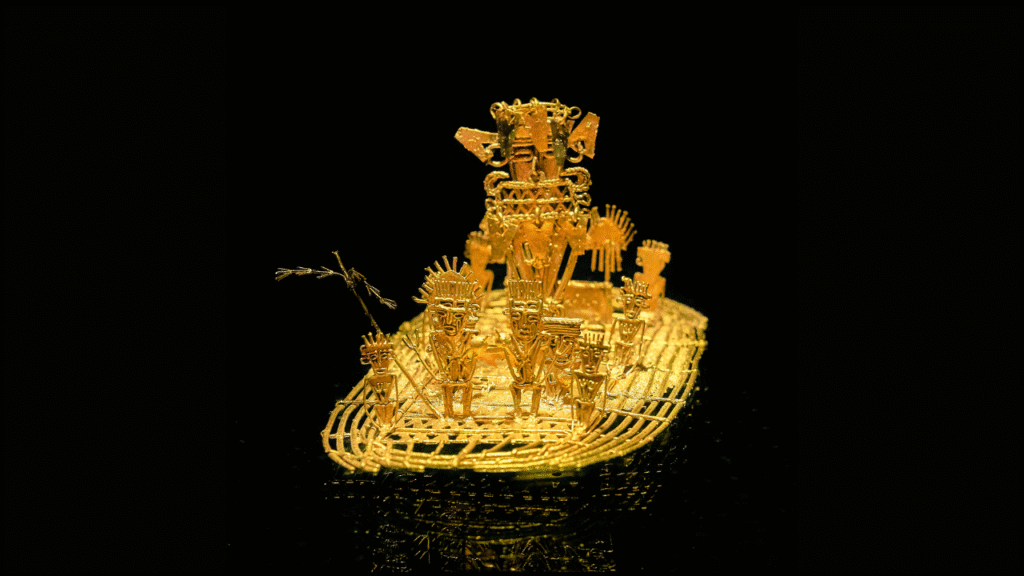
- The leader covered his body with gold dust and sailed on a raft laden with treasures to the center of the lake.
- Offerings of gold, emeralds, and ceramics were cast into the water to honor the gods and seek divine blessings.
- The ritual symbolized purification, renewal, and the bond between the ruler and the divine world.
- Spanish conquistadors later misinterpreted this ceremony as evidence of a golden city, leading to relentless searches for “El Dorado.”
| Aspect | Details |
|---|---|
| Location | Lake Guatavita, near Bogotá |
| Participants | The new zipa, priests, attendants, and musicians |
| Materials Used | Gold dust, emeralds, ceramics, offerings |
| Purpose | Spiritual renewal and tribute to the gods |
| Outcome | Reinforced the ruler’s divine authority |
| Legacy | Sparked the myth of El Dorado among Europeans |
Major Gold Artifacts and Their Functions
- Tunjos – Small anthropomorphic or zoomorphic figurines used as offerings in sacred places.
- Breastplates (Pectorals) – Large, flat ornaments symbolizing leadership and protection.
- Nose rings (Narigueras) – Represented the ability to breathe divine energy.
- Ear spools (Orejeras) – Signified wisdom and the ability to hear the will of the gods.
- Raft of El Dorado (Balsa Muisca) – A masterpiece depicting the coronation ritual that inspired the El Dorado legend.
| Artifact | Description | Symbolic Meaning |
|---|---|---|
| Tunjos | Miniature votive figures | Offerings to deities for fertility and health |
| Breastplates | Worn by chiefs and priests | Representation of divine protection and power |
| Nose Rings | Circular ornaments worn on the nose | Connection to breath and spiritual vitality |
| Ear Spools | Ear ornaments of gold or tumbaga | Symbol of listening to divine messages |
| Balsa Muisca | Raft-shaped artifact with golden figures | Illustration of the sacred El Dorado ritual |
Economic and Cultural Role of Gold
- Gold was not a medium of trade among the Muisca; salt, textiles, and emeralds were more commonly exchanged.
- The use of gold demonstrated social hierarchy and spiritual status rather than wealth accumulation.
- Chiefs distributed gold objects during ceremonies to strengthen loyalty and unity among the people.
- Gold served as a medium of communication between humans and gods, used in burials and temple offerings.
- The Spanish conquest disrupted this sacred economy, leading to large-scale looting and loss of Muisca heritage.
Rediscovery and Modern Legacy
- Archaeological discoveries, such as the Balsa Muisca housed in the Gold Museum of Bogotá, revived global interest in Muisca art.
- The Gold Museum preserves thousands of artifacts, offering a window into ancient craftsmanship.
- Modern Colombian identity embraces Muisca symbolism as part of its cultural roots.
- Artists and historians reinterpret Muisca motifs to celebrate indigenous heritage and environmental balance.
- The legacy of El Dorado remains a metaphor for human imagination, ambition, and the pursuit of the unknown.
Closing Reflections
Muisca goldwork reflects a civilization that viewed art as a spiritual language connecting the earthly and the divine. Gold, shaped through ritual and reverence, embodied the essence of life and cosmic order. The legend of El Dorado, though distorted by outsiders, originated from the Muisca’s deep respect for nature, leadership, and faith. The golden artifacts that survive today not only represent ancient mastery but also continue to illuminate the values and imagination of a culture that sought harmony between humans and the gods.