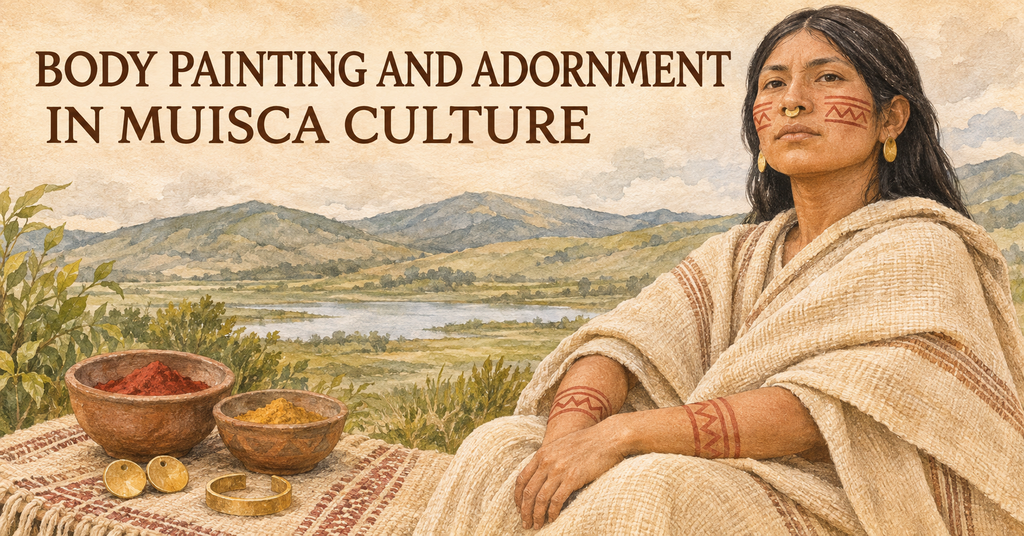
Long before anyone in the Colombian highlands heard of El Dorado, the human body was already a surface for meaning. Among the Muisca, red and dark plant pigments, cotton mantles, feathers, gold nose pieces and ear ornaments told observers who someone was, what role they held and what occasion was underway. A chief, a warrior, a priest and a farmer would not have looked the same at a festival, and the differences were deliberate.
This article looks at that visual language piece by piece: the pigments people put on their skin, the metal ornaments that pierced ears and noses, the cloth that wrapped bodies and carried value, and what recent excavations add to the old chronicle stories. It is written by an independent educational publisher and does not speak for Muisca people today, whose communities have their own views on how ancestral dress and adornment should be shown and discussed.
Table of Contents
Skin as a Canvas: Red and Black Pigments
Two plant colorants come up most often when scholars discuss body paint in the northern Andes and neighboring lowlands. Neither was unique to the Muisca, and both are still used by many Indigenous peoples in South America.
Achiote, the Red Seed
Achiote, known in Colombia as bija, comes from the shrub Bixa orellana. Its spiky pods hold seeds coated in a bright red-orange paste that can be rubbed directly onto skin or mixed with oils. Summaries of Muisca art list achiote among the materials used to paint the body during rituals, a practice shared with many Arawak, Carib and Tupi peoples across the continent. Red carried strong associations in many Andean cultures, though the precise meaning for the Muisca is not recorded in any detail we can trust.
Jagua, the Fading Blue-Black
Jagua comes from the fruit of Genipa americana. Its juice is nearly clear when applied, then darkens on contact with skin over several hours into a blue-black stain that lasts for days or a couple of weeks. Accounts of Muisca warfare say that guecha warriors, the frontier fighters, painted their bodies with inks from this tree. That detail reaches us through Spanish writings, so it should be read as a reported practice rather than an eyewitness certainty for every period.
Patterns, Not Only Colors
Ceramic figures give a hint of design. In a 2021 study of Muisca goldwork and its context, María Alicia Uribe Villegas, Marcos Martinón-Torres and Juan Pablo Quintero Guzmán noted that many richly dressed ceramic effigies show bodies painted with dots, which they suggest probably evoke jaguar fur. Since chiefs were linked to feline power, a spotted body could have signaled status as well as beauty. Summaries also mention tattooing as a marker of identity, though the evidence is thinner than for paint.
Gold Close to the Face
Metal ornaments are the best preserved part of Muisca adornment, and the most misunderstood. Muisca smiths worked mostly in tumbaga, an alloy of gold and copper with some silver, and they cast many pieces using the lost-wax method. In this technique a wax model is encased in clay, the wax is melted out, and molten metal fills the hollow.
Narigueras: Nose Ornaments
Nose ornaments, called narigueras in Spanish, hung from a pierced septum. Some are simple crescents. Others, rectangular and full of fretwork with bird heads, rank among the largest and most complex Muisca metal pieces, and specialists tie those rare forms to chiefly status. A Spanish account from around 1540 states that chiefs pierced their ears and noses to wear gold after completing a period of seclusion, which links the ornament to a rite of passage rather than simple fashion.
Ear Ornaments, Pectorals and Diadems
Ear pendants, chest plates called pectorals, diadems and crowns completed the formal look. The main figure on the Muisca Raft wears trapezoidal ear pendants, and a funerary set from Sogamoso includes a crown with earring pendants. Accounts of warfare claim that the number of earrings a warrior wore reflected enemies defeated, a detail worth treating as a chronicler’s report rather than settled fact.
Gold Dust on Skin
The most famous Muisca body treatment is the one described in the El Dorado accounts. Colonial writers, Juan Rodríguez Freyle among them, said that a new ruler was stripped, coated with a sticky substance and then dusted with powdered gold before offerings were made on a lake. Here the body itself became a golden object for a single ritual moment. Rodríguez Freyle wrote nearly a century after the conquest, relying on what he had been told, so the details are secondhand. The core idea, that a person could be temporarily transformed through what covered the skin, fits well with everything else known about Muisca paint and ornament.
Feathers and Animal Skins
Plumage had to be traded in from warmer lands, which made bright feathers precious in the highlands. Priests and caciques wore them in major ceremonies, and festival dancers reportedly used animal skins, often jaguar, along with feathered headdresses. Very little of this survives in the ground, so our knowledge rests on written descriptions and on what metal figures appear to show.
| Adornment | Material or source | What it may have signaled |
|---|---|---|
| Red paint | Achiote (bija) seed paste | Ritual participation; color meaning not recorded in detail |
| Dark paint | Jagua fruit juice | Reported for guecha warriors; lasting stain for longer events |
| Nariguera | Tumbaga or gold, cast or hammered | Rite of passage; complex forms linked to chiefly rank |
| Ear pendant | Tumbaga, sometimes hollow | Ceremonial role; some made only for burial |
| Pectoral | Hammered or cast metal | Visible authority at public events |
| Feathers | Traded bird plumage | Used by priests and caciques in major rituals |
| Painted mantle | Cotton cloth with plant and mineral dyes | Wealth, tribute and reward |
What the Nueva Esperanza Excavations Changed
For a long time, the picture of Muisca adornment came mostly from chronicles and from museum pieces with little information about where they were found. Large rescue excavations at Nueva Esperanza, in Soacha just south of Bogotá, carried out during construction of an electrical substation, have helped fix that. The site spans roughly two thousand years, from the Herrera period through the Early and Late Muisca periods.
A 2025 study in the ICANH journal Arqueología y Patrimonio, by Agnese Benzonelli and colleagues, examined metal objects from the site. Its findings complicate easy stories about gold and power:
- About 94 percent of the metal objects were personal adornments, and roughly 84 percent came from burials, usually one piece per person.
- Nose ornaments appear as early as the Herrera period and continue into the Late Muisca period.
- Some nose pieces were deliberately bent before burial, a kind of ritual “killing” seen only in Early Muisca contexts.
- Several ear ornaments still held their clay casting cores and showed no wear, so they were probably made specifically to go into a grave.
- Wear on other pieces shows that many ornaments were used in life before burial.
The authors found no clear link between metal ornaments and inherited rank. They suggest gold more likely marked ceremonial roles or temporary prestige, controlled at the household level. That is a useful corrective to the image of a gold-hoarding aristocracy that the El Dorado legend encourages.
Cloth That Carried Value
If gold catches the eye in museums, cotton mattered more in daily life. Muisca weavers, mostly women, produced mantles from cotton and coarser cloth and cord from fique fiber. The cool highlands were poor cotton country, so much raw cotton came through trade, especially from warmer lands toward Sogamoso and the lower valleys.
Mantles as Tribute and Exchange
Historian Germán Villate Santander of the Universidad Pedagógica y Tecnológica de Colombia describes cotton mantles as the backbone of tribute. Local captains reportedly gave five to eight mantles, while ordinary people gave one or two. Drawing on Aguado, he notes that a load of cotton could be exchanged for one good mantle or for several smaller, rougher ones. Fine mantles also circulated in markets and sometimes functioned as small units of value. Chiefs, in turn, gave painted mantles back to captains as rewards, so cloth flowed both up and down the social ladder.
Dyes and Decoration
Colors for textiles came from seeds, flowers, fruits, roots, the cochineal insect and colored clays. Summaries of Muisca art say color could be applied with pencils, dyed threads or stamps. Archaeologists have found clay stamps at highland sites, and whether some were also pressed onto skin remains an open question. It is safest to say they were used on cloth and possibly on bodies.
Dressing for the Occasion
Putting the pieces together, Muisca appearance worked like a set of layers that could be added or removed depending on the event.
- Everyday wear centered on cotton mantles, with simple ornaments at most. Some accounts claim a law attributed to the zipa Nemequene limited jewelry among commoners, though that “code” survives only through later Spanish writing.
- Festival dress added paint, feathers and, for some, animal skins, often jaguar, along with masks and headdresses.
- Warrior dress reportedly included dark body paint, gold nose and ear pieces, feathered crowns and layered cotton mantles that also served as padding.
- Funerary dress wrapped the dead in fine textiles with ornaments, some made only for burial.
Tunjos: The Body Without a Body
Tunjos, small flat votive figures mostly in tumbaga, often show people wearing the very items described here: nose pieces, headdresses, mantles and objects held in the hands. They were left in lakes, caves, temples and graves as offerings. Seen together in the Museo del Oro of the Banco de la República, they offer one of the best visual references for how the Muisca imagined a properly adorned person.
Seeing It Respectfully Today
Muisca communities continue today, with recognized cabildos in Suba and Bosa in Bogotá and in Cota, Chía and Sesquilé. Some members use achiote, woven mantles and ancestral symbols in ceremonies and public events. That is their heritage to interpret. Outsiders should avoid copying sacred designs for costumes or social media, and should ask before photographing anyone in ceremonial dress.
Practical Advice for Visitors and Learners
- Museums first. The Museo del Oro and the Museo Nacional in Bogotá display metal ornaments and textiles with context. In Sogamoso, the Museo Arqueológico, managed by the public Universidad Pedagógica y Tecnológica de Colombia, shows highland material close to where it was found.
- Buy reproductions ethically. Choose pieces clearly sold as modern, ideally from Indigenous or local artisans who are named. Colombian law treats archaeological objects as property of the Nation, so anything offered as an ancient original is a red flag.
- Test plant pigments carefully. If an artisan offers achiote or jagua body art, remember that jagua stains for days and some people react to plant dyes, so a small skin test is sensible.
- Prepare for the highlands. Bogotá lies at about 2,600 meters. Hydrate, rest the first day and carry travel insurance that covers medical care.
- Study further. Courses in anthropology, archaeology or art history explain how scholars date and interpret ornaments, and Spanish reading skills open up the Colombian research.
Layers of Color, Layers of Meaning
Muisca adornment was a system, not a collection of pretty objects. Red achiote and dark jagua marked bodies for ritual and war. Gold nose and ear pieces announced passage into new roles, and some were made only to accompany the dead. Cotton mantles carried tribute, wealth and reward. New excavations suggest that gold marked roles and moments more than permanent rank, which makes the old treasure narrative look thin.
The best way to appreciate this heritage is with context and care: in public museums, through solid scholarship, and with respect for the Muisca people who still decide how their ancestors’ symbols are worn and shared.
Common Questions on Muisca Adornment
Did ordinary Muisca people wear gold?
Some did, at least in burial. Excavations at Nueva Esperanza found single ornaments with many individuals, which suggests metal was not limited to a tiny elite. Colonial writers claimed jewelry was restricted for commoners, but those claims come from later Spanish sources and may describe only certain places or periods.
What is the difference between achiote and jagua?
Achiote gives a red-orange color that sits on the skin and washes away fairly easily. Jagua goes on almost clear and darkens into a blue-black stain that lasts for days. Both are plant-based and widely used across South America, not only by the Muisca.
Why were mantles so valuable?
Cotton grew poorly in the cold highlands, so raw fiber had to be traded in, and weaving a fine mantle took many hours. That made mantles a practical store of value, used for tribute, market exchange and gifts between chiefs and their captains.