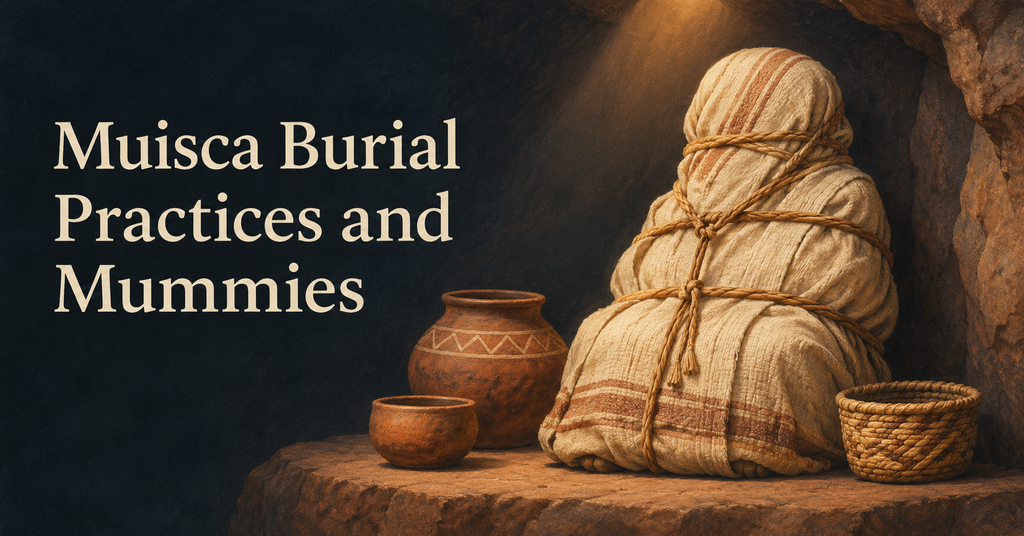
How a society treats its dead says a great deal about how it understood family, power and the world beyond this one. For the Muisca of the Colombian highlands, death did not always mean burial. Most people were laid in graves, often with care that archaeologists can still read centuries later, while some leaders and their relatives were preserved as mummies and kept among the living in caves, temples and houses.
This article explains what is known about both traditions, how researchers study them and why the bodies now held in museums raise real ethical questions. It comes from an independent educational publisher and does not speak for Muisca people, who live today in Bogotá, Boyacá and Cundinamarca and have their own views on how their ancestors should be treated. We separate what archaeology shows from what Spanish chroniclers claimed, since those writers were hostile witnesses to Muisca religion.
Table of Contents
Two Paths for the Dead
The evidence points to two broad practices. The great majority of Muisca people were buried in the ground, in pits and shaft tombs dug near or under settlements. A smaller group, mainly rulers, priests and members of high-ranking families, received artificial mummification and were not buried at all, at least not in the usual sense.
These were not separate religions. Both treatments reflect the same concern with ancestors, lineage and the land. A mummified chief remained a visible presence who could be consulted, carried or honored. A buried grandmother in a village plot still marked her family’s tie to the fields around her. Understanding that shared logic matters more than ranking one practice above the other.
Reading Graves at Marín
One of the most detailed studies of ordinary Muisca burial comes from Marín, a small settlement of about three hectares in the Samacá valley of Boyacá. Archaeologist Ana María Boada excavated there between 1986 and 1991 and analyzed 65 tombs from the fourteenth century.
Tomb Shapes and Body Positions
Graves ranged from about 30 centimeters to 1.7 meters deep. Some were oval pits that held bodies lying on their side in a flexed, fetal position. Others were circular shafts, with or without a small side chamber, where people were placed upright and flexed. Some individuals were seated, and those graves tended to be deeper. Stones sometimes closed the entrance.
Wrapping, Plaster and Pigment
The treatment of the body was striking. About 57 percent of burials showed a complete coating of ash plaster and textile wrapping, and another 23 percent were partly plastered. A few remains carried traces of red ocher, and a small number of people were placed in cooking pots. Burn marks on one skeleton suggest slow drying may have been part of the rite, a possible link to mummification.
What Rank Looked Like
Most tombs held only one or two objects. A few individuals had seven to ten, including emeralds and marine shells that came from far away. The most surprising finding concerned ten people with artificial cranial shaping, a mark of rank. They were buried in deep, seated positions on the central terrace near a large palisaded house, yet they had very few grave goods. Boada argued that this elite held power through gift-giving and ancestor worship rather than by hoarding wealth.
Cemeteries Beneath Modern Bogotá and Soacha
Construction around the capital keeps revealing burial grounds. At Hacienda El Carmen in Usme, on Bogotá’s southern edge, roadwork for a housing project exposed a Muisca cemetery. Excavators recovered 135 sets of human remains from just 400 square meters, roughly one tomb every 3.2 square meters, and estimated that thousands more may lie in the rest of the property. Dates from the site span many centuries, and one man was dated to around 1520 to 1560, close to the conquest. The Colombian Institute of Anthropology and History (ICANH) declared the area an archaeological protection zone in 2012, and plans for a park-museum there have included a ceremonial house for Muisca use.
In Soacha, work on an electrical substation turned up 612 human bones and 88 ceramic pieces at the Nueva Esperanza site, part of a settlement occupied for around 1,800 years, from the Herrera period through Early and Late Muisca times. Discoveries like these show that Muisca burial was tied to everyday villages, not only to remote sacred caves.
How Muisca Mummies Were Prepared
Written sources and laboratory studies together outline several methods, which varied by place and period.
- Drying with heat and smoke. Fray Pedro Simón described bodies dried over a fire. Smoke deposits chemicals such as phenols that slow decay, which helps explain why some bodies survived for centuries.
- Removing organs. Friar Esteban de Asencio wrote in 1550 of evisceration and the use of a powdery balm, possibly a resin called moque. Scans show that some mummies were eviscerated while others were not.
- Wrapping in cloth. Dried bodies were wrapped in several layers of cotton mantles, many of them painted, creating a bundle in a seated, flexed posture.
- Adding precious items. Some accounts mention emeralds placed in the mouth and over the eyes and navel.
The finished mummies were set on raised platforms of reed, called barbacoas, or on small wooden seats, inside caves, temples or special houses. Radiocarbon studies indicate that artificial mummification in the region was practiced for more than 1,600 years, and one researcher traces it to at least the ninth century in the Leyva valley.
Whose Bodies Were Kept
Mummification was mostly reserved for the top of society: zipas, zaques, caciques, priests and their families. Children were included in some cases. In 2007, a mummified baby was found at Gámeza with a small bowl, a teether and cotton cloths, a tender glimpse of how one family prepared a child for the afterlife.
Spanish records describe large gatherings of the dead. In 1602, colonists reported 150 mummies in a cave at Suesca, arranged in a circle around the mummy of a cacique. The Sun Temple at Sogamoso also held the mummies of important people when soldiers entered it in 1537. Such arrangements suggest that ancestors were organized by rank and lineage, almost like a council.
The table below lists several well-documented cases and where they are now.
| Case | Key findings | Current location or status |
|---|---|---|
| Sátivanorte SO10-IX | Adult man about 30, dated about 1300 to 1370 CE; possibly a ritual specialist | Donated to Silva Celis in 1962; later studied in the laboratory |
| Gachantivá | Eviscerated mummy dated to about 1270 CE | British Museum, London |
| Pisba | Heat-dried, not eviscerated, wrapped partly in sheep wool; postconquest date | Museo del Oro, Bogotá |
| Gámeza infant | Baby buried with bowl, teether and cotton cloth (found 2007) | Museo Arqueológico de Sogamoso |
| Suesca cave | 150 mummies in a circle around a cacique (reported 1602) | Known only from colonial records |
| Marín, Samacá | 65 tombs; ash plaster, textile wrapping, cranial shaping among elite | Excavation archive and publications |
| Usme, El Carmen | 135 individuals in 400 square meters; many more estimated | ICANH protection zone since 2012 |
The Pisba Mummy and the Problem of Labels
Museum labels can make a mummy look like a simple example of “Muisca culture.” The Pisba mummy, bought by the Museo del Oro, shows why that is risky. Physical anthropologist Felipe Cárdenas Arroyo found through X-rays and CT scans that the body was dried by heat and not eviscerated. A gourd tied to the chest held small offerings, and a cloth was placed between the teeth.
The surprise came from the wrapping. Part of it was sheep wool, an animal brought by Europeans, and radiocarbon dating placed it around the time of the conquest or after. Cárdenas also argued that Pisba was probably Uwa (Tunebo) territory rather than Muisca, and that Muisca-style pottery in the burial did not prove otherwise. The lesson is simple: provenance, dating and cultural attribution must be checked, not assumed.
Chronicles, Laboratories and What Each Can Tell Us
Spanish writers including Gonzalo Jiménez de Quesada, Pedro Simón, Pedro de Aguado and Gonzalo Fernández de Oviedo described Muisca funerals, often to condemn them. They looted tombs for gold, so their interest was rarely neutral. Their accounts remain useful for details that no excavation can recover, such as songs, mourning periods or the placement of mummies, but they need to be cross-checked.
Modern science offers other tools. Radiocarbon dating, CT scanning, isotope analysis and studies of disease in bones have been applied to Muisca remains by researchers such as Eliécer Silva Celis and, more recently, Abel Fernando Martínez Martín and colleagues. These methods have shown, for example, that mummies were made over a long span of centuries and in several ways, not by one fixed recipe.
Gaps in the record matter too. Many cave burials were emptied by treasure hunters long before any scientist arrived, which means bodies lost their context, offerings were sold off and the people who placed them there left no account of their own. When a source is silent on a region or period, that silence often reflects looting and neglect rather than a real absence of burial customs.
Ancestors, Not Curiosities
Every mummy and skeleton in a collection was a person with a family. For many Muisca people today, these are ancestors, and seeing them in glass cases can be painful. Around the world, Indigenous groups have challenged museums over displaying and storing human remains, and debates about consultation, reburial and the return of bodies held abroad have reached Colombia too. Positions differ, even within communities, and there is no single answer that fits every case.
A few principles are widely accepted. Remains should be handled with dignity, research should involve descendant communities where possible and display should serve understanding rather than shock. In Colombia, archaeological heritage, including burials, is protected by law and managed under ICANH oversight, and digging up graves without authorization is illegal. The plans at Usme, which involve community input and a ceremonial space next to the remains, point to one possible way forward.
Visiting Collections Thoughtfully
If you want to learn more in person, Bogotá’s Museo del Oro and Museo Nacional and the Museo Arqueológico de Sogamoso all address Muisca funerary practice. A few habits make the visit more respectful and more rewarding:
- Read the labels for provenance and dating, and notice when a museum admits uncertainty.
- Follow photography rules around human remains, and consider not photographing them even where it is allowed.
- Book a museum guide or a licensed regional guide, who can explain context that labels leave out.
- Bogotá, Tunja and Sogamoso are all well above 2,500 meters, so pace yourself and carry travel insurance with medical cover.
- If the subject grips you, university courses in bioarchaeology, anthropology or Colombian history go much further than any single exhibition.
Keeping Faith With the Dead
Muisca burial customs reveal a society that took great care with its dead, whether by plastering and wrapping a body in a village grave or by drying, wrapping and seating a chief among the ancestors in a cave. Archaeology at Marín, Usme and Soacha shows ordinary families honored in the ground, while mummies from Sátivanorte, Gachantivá and Gámeza show long and varied traditions of preservation. The same evidence carries obligations. Getting the facts right, questioning biased chronicles and treating remains as relatives of living people are the best ways to honor what these burials still teach.
Burial and Mummy Questions Worth Asking
Were all Muisca people mummified?
No. Most were buried in pits or shaft tombs, often wrapped in cloth and sometimes coated with ash plaster. Artificial mummification was mainly reserved for rulers, priests and high-ranking families, although some children of those families were also preserved.
Where are Muisca mummies kept today?
Some are in Colombian museums such as the Museo del Oro, the Museo Nacional and the Museo Arqueológico de Sogamoso, while others are held in institutional collections, including ICANH, and at least one is in the British Museum. Not every mummy labeled Muisca has a secure attribution, so researchers continue to review them.
Is it disrespectful to view mummies in a museum?
It depends on how you approach it. Many Muisca people feel strongly about the display of ancestors, and their views vary. Visiting with a learning purpose, following museum rules, avoiding casual photos and taking time to understand the person behind the remains are reasonable ways to show respect.