Nobody alive has heard a Muisca song as it sounded in 1500. That simple fact shapes everything we can say about music in the highlands around Bogotá and Tunja before the Spanish arrived. What survives is a scatter of clues: clay whistles and flutes pulled from excavations, shell trumpets mentioned again and again by colonial writers, a gold offering that seems to show a ceremony in progress, and court papers written by officials who wanted Indigenous festivals stopped, not understood.
This guide pulls those clues together as carefully as the evidence allows. It explains which instruments are reasonably well documented, what the written sources actually say and why they need a skeptical reading, and how present-day Muisca communities have brought music back into public ceremony. We are an independent educational publisher. We do not speak for the Muisca, and where the record is thin, we say so plainly rather than filling the gaps with romance.
Table of Contents
Listening Through Broken Sources
Three kinds of evidence exist, and each one has a different weakness. Archaeology gives us real objects, but sound does not fossilize. A ceramic flute tells you its finger holes and pitch range, not the melody someone played on it or the occasion that called for it. Drums, which were almost certainly common, are made largely of wood and hide, and those materials rot in the damp highland soil.
Written sources come mostly from Spanish chroniclers of the sixteenth and seventeenth centuries, among them Juan de Castellanos, Pedro de Aguado, Fray Pedro Simón and Lucas Fernández de Piedrahita. These men wrote from inside a colonial project. Many saw Muisca ritual as idolatry, and their descriptions of song and dance often come wrapped in disapproval. Some never witnessed the events they describe and copied from earlier writers.
The third source is the most surprising: legal records. When colonial authorities prosecuted Indigenous leaders for holding traditional gatherings, clerks wrote down what witnesses saw. These documents were hostile in purpose, yet they sometimes preserve details no chronicler bothered to record.
Why the Word “Sad” Keeps Appearing
Several Spanish writers described Muisca singing as mournful or monotonous. Treat that judgment with care. European listeners trained on church polyphony and courtly dance often heard unfamiliar scales and long repetitive cycles as gloomy. Repetition in ritual music frequently has a purpose, helping a crowd move together for hours. The label tells us more about the listener’s ear than about the singers’ feelings.
Wind, Shell and Clay: The Instrument Families
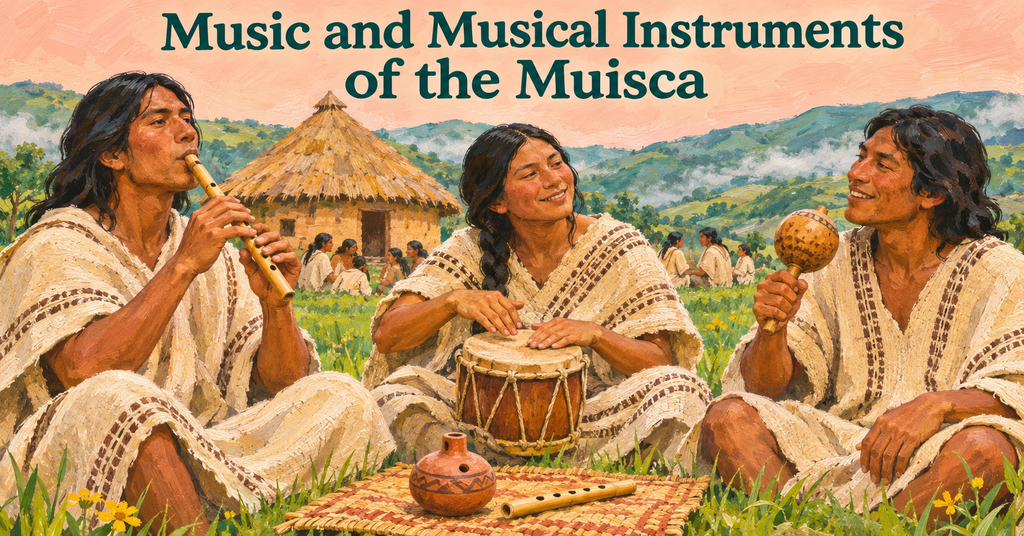
Most of what can be said about Muisca instruments falls into a few groups. Wind instruments dominate the surviving material, largely because clay, bone and shell outlast everything else.
Flutes and Panpipes
Flutes made of cane, bone and fired clay appear across the northern Andes. Chronicle passages about Muisca festivals mention pipes and panpipes, and the related Spanish terms caramillos and zampoñas show up in accounts of highland celebrations. Cane rarely survives, so the bone and ceramic examples in collections likely represent only a slice of what people actually played.
Ocarinas and Whistles
Small vessel flutes, often called ocarinas, are hollow clay bodies with a mouthpiece and a few finger holes. Many in Colombian collections are shaped like birds or other animals. They are well known from several Colombian cultures, and summaries of Muisca ceremonial life list ocarinas alongside trumpets, drums, rattles and bells. Assigning a particular piece to the Muisca rather than a neighboring people depends on where it was found, which is one reason excavation records matter so much.
Fotutos: The Shell Trumpets
The fotuto is the instrument that turns up most often in discussions of Muisca music. The word generally refers to a trumpet made from a large marine shell, though ceramic versions also existed in the wider region. Sea shells had to travel a long way to reach the Altiplano Cundiboyacense, so a shell trumpet was itself a sign of trade networks reaching toward the coasts. Its blast carries far across open valleys, which suits signaling, processions and calls to assembly.
Rattles, Drums and Bells
Rattles made from gourds or clay, sometimes holding a small pebble or seeds, were easy to make and easy to play while dancing. Drums are described in written accounts more often than they are found in the ground. Small metal bells and dangling ornaments also made sound, so dress and music overlapped in ways that are easy to forget when looking at a silent museum case.
| Instrument | Likely materials | How strong is the evidence? |
|---|---|---|
| Fotuto | Large marine shell; possibly clay copies | Repeatedly named in colonial writing; shells point to long-distance exchange |
| Flute | Cane, bone, fired clay | Mentioned in a 1563 legal case; cane examples rarely survive |
| Panpipes | Cane or bone tubes bound together | Named in chronicle passages on festivals; few securely Muisca finds |
| Ocarina | Fired clay, often animal-shaped | Common in Colombian collections; cultural attribution depends on find context |
| Rattle | Gourd or clay with seeds or a pebble | A rattle appears in the hands of a figure on the Muisca Raft, per specialists |
| Drum | Wood and animal hide | Described in writing; organic parts decay, so physical proof is scarce |
A Gold Offering That Seems to Make Noise
The Muisca Raft, held by the Museo del Oro of the Banco de la República in Bogotá, was found in 1969 in a cave near Pasca, where it had been left as part of an offering. It is a small cast piece, under 20 centimeters long, made by lost-wax casting in an alloy of gold, silver and copper. It is usually linked to the investiture ritual behind the El Dorado story.
For anyone interested in sound, the raft rewards a close look. In a 2021 study of the piece, María Alicia Uribe Villegas, Marcos Martinón-Torres and Juan Pablo Quintero Guzmán noted that two standing figures carry a rattle and an animal-shaped mask. That small detail suggests the scene was imagined as loud and active rather than silent. It is one of the rare cases where a Muisca object appears to show an instrument in use.
Be careful not to read too much into it. A votive figure is a symbolic object made for the spirit world, not a photograph. Still, it supports what written sources suggest: important ceremonies brought together music, masks, special dress and a crowd.
The 1563 Ubaque Gathering as a Sound Record
One of the richest written descriptions of Muisca ritual sound comes from a colonial prosecution. In 1563 the cacique of Ubaque, east of Bogotá, hosted a large gathering, and Spanish authorities later investigated it as an idolatrous event. Historian Juan F. Cobo Betancourt, in a 2024 Cambridge University Press book on the Muisca and Spanish colonialism, summarizes witness accounts that mention groups playing flutes, conch shells and other instruments.
The same testimony describes people singing what Spanish observers called sorrowful songs in a language they could not understand, dancing with banners along a causeway, and wearing masks and headdresses. Large quantities of chicha, the fermented maize drink, were supplied by the host. Witnesses said they had come to celebrate and to drink.
Two lessons stand out. First, music was communal and tied to hospitality, not a performance for passive listeners. Second, the fact that we know this at all is owed to an effort to suppress it. That uncomfortable irony runs through much of Muisca history.
Occasions That Called for Music
Pulling together the chronicles and later scholarship, music appears linked to a recognizable set of moments:
- Agricultural work, including field preparation, planting and harvest, timed by the Muisca calendar.
- The installation of a new cacique, when leaders took charge of their lands.
- Building or renewing important houses, which accounts describe as festive work.
- Preparation for war, with songs recalling earlier battles and asking for victory.
- Mourning and the honoring of the dead.
- Offerings to the Sun (Sué) and the Moon (Chía), according to colonial descriptions of Muisca religion.
Musicologist Egberto Bermúdez, writing on Colombian Indigenous music more broadly, notes that sixteenth-century accounts often describe dances where a leader sings and participants answer in chorus. That call-and-response structure fits the picture of long communal gatherings well.
Neighbors Help Fill the Silence
Comparing nearby peoples can sharpen the picture, as long as nobody pretends the cultures were identical. The Guane of present-day Santander bordered Muisca territory to the north. A 2012 study by Manuel Mejía Serrano described Guane instruments recovered from burials and caves, mostly in the Mesa de los Santos area: cane quenas, a bone quena, ceramic and cane ocarinas, a set of bone panpipe tubes and a pair of maracas.
Those finds show the kinds of instruments that could survive in highland caves under good conditions. They also show that music went into graves, which hints that sound mattered in the passage from life to death. For the Muisca, comparable finds are fewer, so the Guane material works as context, not proof.
Music in Muisca Communities Today
It is a mistake to talk about Muisca music only in the past tense. Muisca cabildos, the recognized community governments, operate today in Suba and Bosa in Bogotá and in Cota, Chía and Sesquilé in Cundinamarca. Their ceremonies are living practice, shaped by both ancestral memory and centuries of change.
The Jizca Chía Zhúe Festival in Bosa
The Muisca community of Bosa, which received recognition from the Ministry of the Interior in 1999, has held a festival called Jizca Chía Zhúe since 2001. The name refers to the union of the Moon and the Sun, and the event is also known as the wedding of the Sun and the Moon. In recent years the community has scheduled it near a solstice or equinox. Bogotá’s culture authority recognized it as part of the district’s intangible cultural heritage through Resolution 935 of 2023.
According to the community’s heritage application, the festival mixes string, wind and percussion music drawn from Andean and highland traditions with processions, ritual dance and, at night, popular dance music. Women, young people and children have taken leading roles in recovering the community’s own dances. That blend is honest about history. Living traditions borrow and adapt; they are not museum replicas.
Respect at Public Events
If you attend a public Muisca event, follow the hosts’ lead. Ask before photographing ritual moments, do not join a dance uninvited, and remember that some ceremonies are open to visitors while others are not. Community members, not outside writers, decide what their music means today.
Hearing the Past More Clearly
For travelers, students and teachers, a few steady habits make this topic far more rewarding.
- Start at the Museo del Oro. Look for the Muisca Raft and for ceramic wind instruments in the collections, and read the labels for find sites.
- Visit the Museo Nacional. Its archaeology and history galleries help place Muisca objects in a longer national story.
- Plan for altitude. Bogotá sits at roughly 2,600 meters. Give yourself a slow first day, drink water and check that your travel insurance covers medical care at altitude.
- Use licensed guides. For trips out to Boyacá or rural Cundinamarca, a guide registered with Colombia’s national tourism registry can add context and help you avoid trespassing on private or sacred land.
- Study the sources. University courses in anthropology, ethnomusicology or Latin American history teach how to read colonial texts critically, and many are open to non-degree students.
- Learn some language. Spanish is essential for most primary sources. Several community and university programs offer introductions to Muysccubun, the Muisca language, though revitalization work varies in approach and should be approached with humility.
Instruments as Souvenirs
Craft markets sell replica ocarinas and shell trumpets. A clearly labeled modern reproduction made by a named artisan is a reasonable purchase. Never buy anything offered as an ancient original. Under Colombian law, archaeological objects belong to the Nation, and trading them feeds looting of graves and sacred sites.
An Echo Worth Protecting
Muisca music survives as an echo rather than a recording. We can name the instruments with fair confidence: shell trumpets, flutes and panpipes, clay ocarinas, rattles and drums. We know music joined feasts, farming, war, mourning and the honoring of leaders and deities. We know Spanish observers heard it through prejudice, and that much of the best description was written by people trying to end it.
The more important point is that the story did not stop in the sixteenth century. Muisca communities in Bogotá and its surroundings are shaping their own ceremonial music today, and they are the ones who carry its meaning forward. Listening respectfully, both to the evidence and to living people, is the best way to learn.
Questions Listeners Often Ask
Can I hear authentic ancient Muisca music anywhere?
Not in the strict sense, because no melodies were written down before the conquest. Some recordings play reproductions of ancient instruments, which can give a sense of their timbre, but the tunes are modern interpretations. Living Muisca ceremonies offer a different and valuable experience, as present-day practice rather than reconstruction.
What is a fotuto made of?
Usually a large sea shell with an opening cut or ground at the tip to form a mouthpiece, played like a trumpet. Clay versions also existed in the wider region. Because the Muisca highlands are far from the sea, shell examples point to trade with coastal or lowland peoples.
Are the Spanish chronicles reliable about Muisca songs?
Only partly. Chroniclers wrote with religious and political aims, sometimes decades after the events, and often borrowed from one another. Read them alongside archaeology, colonial court records and the perspectives of Muisca communities, and treat emotional labels like “sad” as the opinions of outsiders.