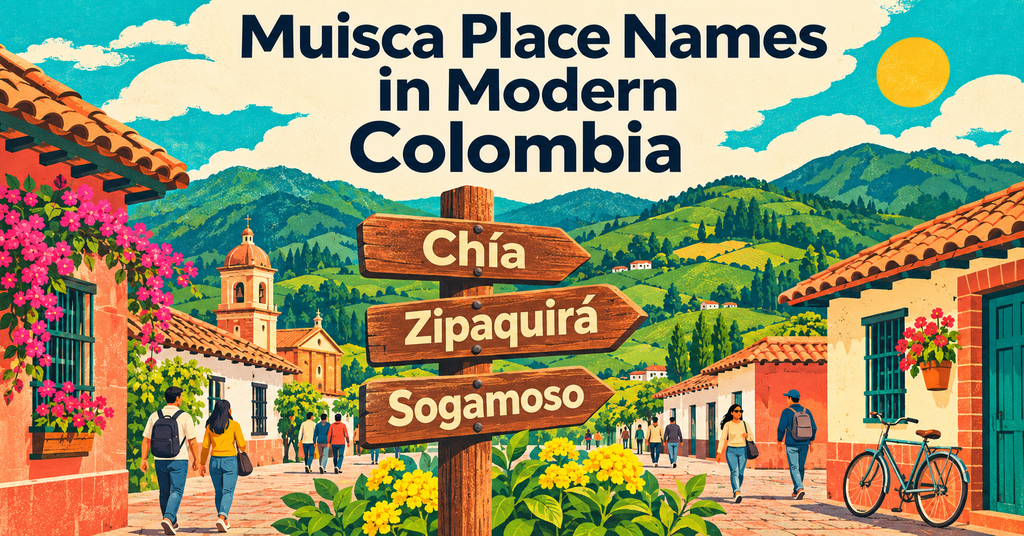
Drive north out of Bogotá and the road signs read like a word list from a language almost nobody speaks: Chía, Cajicá, Zipaquirá, Nemocón, Tocancipá, Sesquilé. Head toward Boyacá and you pass Chocontá, Tunja, Sogamoso and Duitama. These names come from the Muisca, the people who lived on the high plateaus of the Eastern Andes when the Spanish arrived in the 1530s. The Spanish kept many of them, bending the spelling to fit their own ears, and they survived long after the language itself stopped being spoken in daily life.
This guide explains what is known about Muisca place names, which meanings are fairly well supported, which are guesses, and which popular explanations are probably wrong. We are an independent educational publisher, not a voice for Muisca communities, and we treat proposed translations as proposals. Many of these names have two or three competing meanings in print, and the honest answer is often that scholars are not sure.
Table of Contents
Why the Map Still Carries Muisca Words
When Gonzalo Jiménez de Quesada’s expedition reached the highlands in 1537, it found a dense pattern of towns, each with its own lord and name. The Spanish needed to know where they were and whom to tax, so they recorded those names in documents, tribute lists and land grants. Once a name was written into colonial paperwork, it tended to stay.
The language behind these names, called Muysccubun or Chibcha, belongs to the Chibchan family. It faded as a spoken language during the seventeenth and eighteenth centuries, and in 1770 a royal order from Charles III banned Indigenous languages in the region. The words that remained on the map became fossils: still used every day, but cut off from the speakers who knew exactly what they meant.
Building Blocks to Look For
Researchers point to a few recurring pieces that show up across many names. These are useful clues, though each comes with caveats.
- tá is usually glossed as farm fields or cultivated land.
- ca (or ka) is read as an enclosure or fenced compound, the kind of palisaded residence that housed a lord.
- sua or súa is linked to the Sun.
- gua is associated with mountain or hill.
- chi is often given as “our.”
Names were also taken from caciques, the local lords, so not every name breaks down into description. Some are simply a ruler’s name attached to his town.
Bogotá and the Lost Bacatá
The capital’s name is the most famous example. It comes from Bacatá, the seat of the zipa, the ruler of the southern Muisca. Bacatá was not where central Bogotá stands today. It lay near present-day Funza, on the western side of the savanna. When Quesada founded the Spanish town on 6 August 1538 near the hills on the eastern edge, the name of the old Muisca capital moved with it, eventually settling as Santa Fe de Bogotá.
The meaning usually given for Bacatá is “enclosure outside the farm fields,” built from the elements for enclosure and cultivated land. Funza, the name of the town that occupies the old site, is glossed as “powerful lord.” The Bogotá River was also once called the Funza.
Names Inside Bogotá
Several of Bogotá’s twenty localities carry Muisca names, a reminder that the city absorbed what were once separate towns.
- Usaquén: linked to a cacique or honorific title, and sometimes glossed as “under the pole.” A dramatic story about a house-building ritual involving girls placed in post holes circulates in popular retellings; treat it as unconfirmed.
- Suba: two theories exist. One connects it to a phrase meaning “my face, my flower.” The other combines words for sun and water.
- Engativá: glossed as “cacique of the land of the Sun,” among other readings.
- Fontibón: “powerful chief.”
- Bosa: an enclosure for the one who guards the cornfields.
- Usme: “nest of love,” a gloss that appears widely but rests on thin evidence.
- Teusaquillo: from Teusacá, glossed as “borrowed enclosure.” Tradition holds it was a place a local leader used for rest and bathing.
Not every old-sounding name is Muisca. Chapinero, for instance, is usually traced to a Spanish word. A local legend credits Antón Hero Cepeda, a maker of chapines, the high wooden-soled shoes of colonial times, and the name was made official by a municipal agreement in 1885. Kennedy honors the U.S. president, whose 1961 visit was tied to a housing project there.
Towns of the Savanna
The towns ringing Bogotá offer the richest set of Muisca names, and some of the most argued-over.
Zipaquirá shows how one name can carry several meanings. Some sources give “city of our father,” others “foot of the zipa’s hill.” Both tie the town to the zipa, which makes sense given the area’s salt deposits and their value to the southern rulers.
Chía takes its name from the Muisca moon goddess. Cajicá is usually read as “stone fortress,” from the enclosure element plus a word for stone, though some writers prefer to link it to a cacique named Cajic. Facatativá is given as “strong enclosure at the end of the plain,” fitting its position at the western edge of the savanna. Soacha is glossed as “man of the Sun,” or in Spanish sources “sol varón.”
Moving north, Guatavita means “end of the farmlands.” The town has its own modern twist: the original village was flooded by the Tominé reservoir in 1967, and residents moved to a newly built town on its eastern shore. The famous lagoon of Guatavita, linked to the El Dorado ceremony, actually lies within the municipality of Sesquilé. Sesquilé itself is glossed as “hot water” or, in some Spanish sources, as a word for a gap where a stream runs.
Other examples include Tocancipá, “valley of the joys of the zipa”; Gachancipá, “pottery of the zipa”; Nemocón, linked to the zipa Nemequene or translated as “sadness of the warrior”; Tausa, “tribute,” and nearby Sutatausa, “small tribute”; Suesca, “rock of the birds”; Chocontá, “farmlands of the good ally”; and Sopó, “strong hill.” Ubaté has two very different glosses in print, “granary of the gap” and “bloodied land,” which shows how far interpretations can drift.
| Place | Meaning often given | How firm is it? |
|---|---|---|
| Bogotá | From Bacatá, “enclosure outside the farm fields” | Origin in Bacatá is solid; the gloss is a reconstruction |
| Chía | Named after the moon goddess | Widely accepted |
| Zipaquirá | “City of our father” or “foot of the zipa’s hill” | Link to the zipa is likely; wording varies |
| Cajicá | “Stone fortress,” or a cacique’s name | Two readings in circulation |
| Sogamoso | From Sugamuxi, “dwelling of the Sun” | Sun link fits the temple; exact gloss uncertain |
| Tunja | From Hunza, “proud lord” | Origin in Hunza is solid; gloss less certain |
| Cundinamarca | Thought to come from Quechua, “condor’s nest” | Not Muisca at all, by most accounts |
Boyacá’s Muisca Map
The northern Muisca domain, ruled by the zaque, has its own cluster of names.
Tunja comes from Hunza, the zaque’s seat, glossed as “proud lord.” Gonzalo Suárez Rendón founded the Spanish city there on 6 August 1539, a year to the day after Bogotá’s first founding. Sogamoso comes from Sugamuxi, often translated as “dwelling of the Sun,” a fitting name for the town that held the Muisca Temple of the Sun. Duitama takes its name from Tundama, the lord who resisted the Spanish there until 1539. Boyacá, now the name of the whole department, is glossed as “region of the blankets” or “enclosure of the cacique.”
Smaller towns add more variety. Ramiriquí is given as “white earth.” Ráquira, still known for pottery, as “village of the pans.” Iza as “place of healing,” which suits a town known for its hot springs. Gámeza, a place tied to the Bochica myth, as “serf of the Sun.” Tinjacá as “enclosure of the powerful lord.” Chiquinquirá has two readings, “place of swamps covered with fog” and one linked to priests and ceremonies at Lake Fúquene.
Sutamarchán is a good example of a hybrid. Its first part is read as Muisca, while the second part has been linked to Pedro Merchán de Velasco, a later Spanish encomendero who held rights over the local people.
Names That Only Sound Muisca
The department of Cundinamarca is the best-known trap. It sounds as though it belongs with the town names, but most accounts trace it to Quechua, the language of the Inca world, with a meaning along the lines of “condor’s nest.” Spanish soldiers who had served in Peru may have brought the name north. That makes it a borrowed word applied to Muisca lands, not a Muisca word itself.
Other names around Bogotá come from Spanish saints, colonial landowners, haciendas or later events. A quick rule: if a name contains a saint’s name or an obvious Spanish word, it is probably not Muisca, even if it sits next to one that is.
How to Read a Translation Critically
Many websites present Muisca place-name meanings with total confidence. A few habits help you judge them.
- Remember the spelling problem. Colonial priests wrote Muysccubun with Spanish letters, which did not fit all its sounds. Fray Bernardo de Lugo, whose grammar was printed in 1619, even invented a special letter for one vowel. Every name we have has passed through this filter.
- Watch for multiple glosses. If a name has two meanings in print, neither should be stated as fact.
- Separate names of people from descriptions. Many towns were named after their lords. A poetic translation may really be an attempt to explain a personal name.
- Be wary of tidy stories. Folk etymologies often attach a dramatic tale to a name. They can be part of local culture without being accurate history.
- Check whether the name is Muisca at all. Some names in Cundinamarca belong to neighboring peoples or to Spanish.
Linguists at Colombian universities continue to study these questions, and there is still debate about how much of the original language can be reconstructed. Muisca communities who are working to revive Muysccubun also have their own readings of these names, which may differ from academic ones.
Words That Crossed Into Everyday Spanish
Place names are not the only survivors. Some Muisca words passed into the Spanish of the Bogotá region and are still in use. Changua, a breakfast soup of milk, egg and scallions, is one example often cited. Cuchuco, a thick grain soup, is another. Chucua is a local word for a marshy wetland. Hearing these words in a Bogotá kitchen is another way the language still turns up in ordinary life.
Exploring the Names on the Ground
A trip through the Muisca map is easy to plan from Bogotá, which sits at roughly 2,600 meters. A loop north through Chía, Cajicá and Zipaquirá, then on to Nemocón, Guatavita and Sesquilé, covers a dense set of names in a day. Boyacá’s Tunja, Sogamoso, Iza and Ráquira make a longer route.
- Take time to adjust to the altitude before long walks, and carry water and warm layers.
- Travel insurance is worth having for road trips in the highlands.
- Municipal cultural offices can be a good place to ask how a town explains its own name.
- The Museo del Oro of the Banco de la República in Bogotá and the Museo Arqueológico de Sogamoso, run by a public university, give archaeological context.
- Licensed local guides can point out sites and stories that do not appear on signs.
If the subject grabs you, learning Spanish will help most, since nearly all research on Muisca toponyms is published in Spanish. Courses in Andean history or linguistics, many offered online by universities, can take you further.
A Map Written in Two Languages
Every time someone in Colombia says Bogotá, Chía or Sogamoso, they are speaking a Muisca word. These names survived five centuries of colonial rule and modern growth because they were useful, written down and tied to places people kept living in. Their meanings are harder to recover than their sounds, and many translations in circulation are reasonable guesses at best.
That uncertainty is not a reason to ignore them. It is a reason to read them carefully, to prefer “often translated as” over “means,” and to remember that Muisca descendants in Suba, Bosa, Cota, Chía and Sesquilé still live among these names and have their own understanding of them.
Place-Name Questions
What does Bogotá mean?
The name comes from Bacatá, the seat of the southern Muisca ruler near present-day Funza. It is usually translated as “enclosure outside the farm fields,” though that reading is a reconstruction from colonial records rather than a certainty.
Is Cundinamarca a Muisca word?
Probably not. Most accounts trace it to Quechua, the language of the Inca world, and translate it as something like “condor’s nest.” It was likely applied to the region by Spanish newcomers.
Why do sources give different meanings for the same town?
The language stopped being spoken centuries ago, colonial writers spelled it imperfectly, and many names came from local lords rather than descriptions. Researchers and local historians have reconstructed meanings in different ways, so several glosses often circulate side by side.