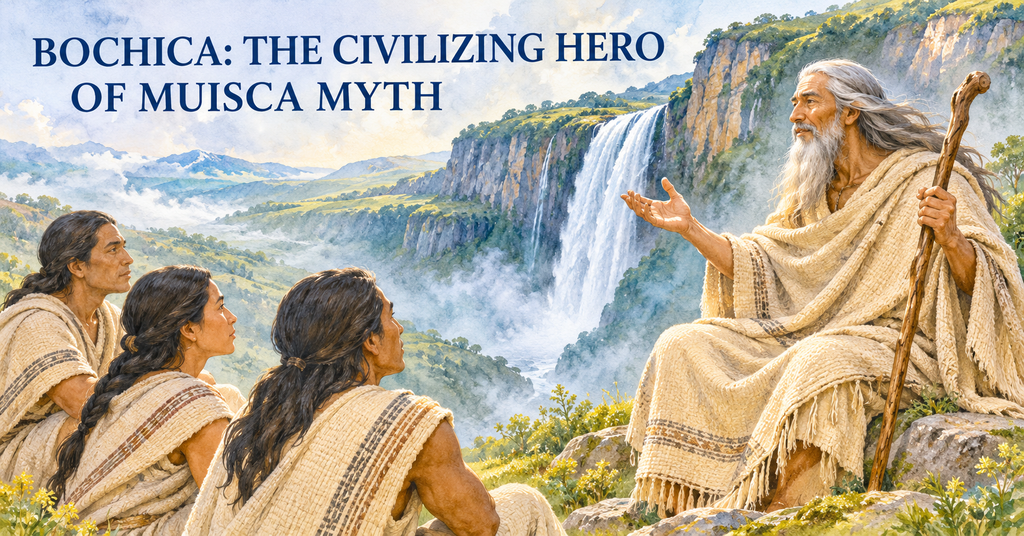
Long before Spanish ships reached the Caribbean coast of what is now Colombia, people on the cold high plateau around Bogotá and Tunja told stories about a stranger who walked into their valleys and taught them how to live. He was old, he wore a long beard and a mantle, and he carried a staff. In most versions, the Muisca called him Bochica. He showed people how to spin cotton, weave cloth and paint it, how to behave toward one another, and how to honor the powers above them. When a great flood drowned the savanna, he opened a way for the water to escape.
This guide looks at who Bochica is in Muisca myth, what the stories say he did, and where those stories come from. That last point matters. Almost everything written about Bochica passed through the hands of Spanish priests and colonial writers, so the figure we read about today is part Muisca memory and part European interpretation. We are an independent educational publisher, not a voice for Muisca communities, and the aim here is to separate what the sources actually record from what later writers added.
Table of Contents
Who Bochica Is in the Stories
Bochica belongs to the religious world of the Muisca, the Chibcha-speaking people who lived across the high basins of present-day Cundinamarca and Boyacá. Above him in that world stood Chiminigagua, often described as the supreme creative power. Bochica appears as a messenger and teacher connected to that power rather than as the creator himself.
Many Names for One Teacher
The colonial records give him several names. Besides Bochica, writers recorded Nemqueteba, Nemquetaha, Sadigua and Chimizapagua. One of his titles has been translated as “messenger of the creator.” Some names may have belonged to different regions, and the Spanish may have merged figures who were originally distinct.
The Old Man With the Long Beard
The physical description is consistent across many retellings: an elderly man with hair and a beard reaching to his waist, dressed in a long mantle and carrying a staff. Some accounts say he came from the east, from the direction of the plains that stretch toward present-day Venezuela. The beard has attracted a lot of speculation, because Muisca men are not described as bearded. A cautious reading is that the beard marked him as old and set apart, and that colonial authors stressed it because it matched their image of a holy preacher.
A Route Across the Highlands
The stories give Bochica a journey, and that journey is tied to real places. In one sequence he appears first at Pasca, south of the Bogotá savanna, and later at Gámeza in Boyacá, where people treated him with hospitality. He is said to have withdrawn for a time to the cave of Toya, where caciques from Tópaga, Tota, Pesca, Firavitoba and other communities came to consult him.
His path eventually leads east to Sugamuxi, the area of present-day Sogamoso. In several accounts this is where his earthly life ends: he dies, vanishes, or rises to become the Sun. Sugamuxi became a sacred center, and the Temple of the Sun that stood there at the time of the conquest was linked in some traditions to his memory. One myth even places the creation of the world at Sogamoso. A monument to Bochica stands in Cuítiva, near Lake Tota, and the reconstructed temple inside the Museo Arqueológico de Sogamoso draws visitors who want to see where these stories were anchored.
What the Teacher Taught
Bochica is above all a bringer of skills and rules. The chroniclers credit him with teaching:
- Spinning and weaving cotton, which produced the mantles the Muisca wore and exchanged as items of high value.
- Painting cloth, including the patterns applied to mantles.
- Agriculture, especially the planting cycles of maize and other crops.
- Moral conduct, such as moderation, honesty and proper behavior within the community.
- Religious ritual, including how to make offerings and keep sacred days.
He was also regarded as a patron of chieftains and goldsmiths, and worked gold was offered to him. This link to goldsmiths is worth noting, since the Muisca were skilled metalworkers who made small votive figures and ornaments from tumbaga, an alloy of gold and copper. A hero who taught crafts and was honored with crafted objects fits neatly into that world.
Some summaries add that he spoke against war and idol worship. Opposition to idols sounds very much like a Christian priest’s idea of a good teacher, so that detail may reflect the chronicler more than the storyteller.
Huitaca, the Rival Voice
Many civilizing-hero stories need an opponent, and Bochica’s is a woman, most often named Huitaca. Where he preached moderation and work, she encouraged dancing, drinking, games and pleasure. In some versions she is beautiful and of lunar origin. In others she is called Bochica’s wife.
The versions disagree about how her story ends. Some say Bochica turned her into an owl, a creature of the night. Others say he transformed her into the Moon, or that she became the Moon so that she would shine only after dark. A few retellings blame her for the flood itself, saying she conjured storms or used magic to swell the rivers.
The name Chía adds another layer. Chía is the Muisca moon goddess, and the town of Chía north of Bogotá carries her name. Some accounts treat Huitaca and Chía as the same figure, while others keep them separate. This is a good example of how hard it is to pin down Muisca belief from colonial texts. Different chroniclers heard different stories from different informants, and they did not always keep careful track of who said what.
The Flood and the Breaking of the Rock
The best-known Bochica story is the flood. The details vary, but the outline runs like this. The people stopped respecting the gods. Chibchacum, a deity who had once been close to them, grew angry and punished them by sending water over the Bogotá savanna. Rivers rose, crops were ruined and many people died. One retelling names the Sopó and Tivito rivers as the streams he used to swell the Funza, the old name of the Bogotá River.
The survivors fasted and made offerings, asking Bochica for help. He appeared on a rainbow, struck the rocks at the edge of the plateau with a golden staff, and split them open. The trapped water rushed out through the gap and fell into the valley below. That opening became the Salto del Tequendama, the waterfall on the Bogotá River southwest of the city, which drops about 157 meters.
Chibchacum did not escape punishment. His sentence was to go below ground and bear the weight of the earth himself, taking over a job once done by wooden props. When he shifts the load from one shoulder to the other, the ground shakes. That is how many retellings explain earthquakes.
What Geology Says
There is an interesting parallel in the landscape itself. The Dutch-Colombian scientist Thomas van der Hammen concluded that a large lake once covered the Bogotá savanna, and that as conditions changed, its waters drained through the Bogotá River and over the Tequendama falls. His dating places this tens of thousands of years ago, long before any human memory could have recorded it. So the myth is not a record of an event people witnessed. It may, however, reflect people looking at a flat basin full of wetlands and a dramatic gorge at its edge and reaching a reasonable conclusion: water was once trapped here and something let it out.
Bochica Among Other Muisca Stories
Bochica is not the only major figure, and it helps to see him alongside the others.
- Chiminigagua is the source of light and creation in several accounts.
- Sué (also written Zuhé or Suá) is the Sun.
- Chía is the Moon.
- Bachué is the mother of humanity. She rose from Lake Iguaque holding a child, who grew up to become her partner. Together they populated the earth, then turned into snakes and returned to the lake. The chronicler Pedro Simón recorded her story.
Reading the Sources With Care
No Muisca account of Bochica written by Muisca people in their own language survives from before or just after the conquest. What we have are Spanish texts.
The earliest known reference comes from testimony recorded in 1563 at Ubaque, east of Bogotá. It is strikingly different from later versions. Witnesses there spoke of Bochica variously as a building, as the father of a “tiger” (likely a jaguar), and as an idol, and one said he “is a wind.” That is a long way from the bearded preacher of the later books.
The polished civilizing-hero version took shape in the seventeenth century, especially in the work of Pedro Simón and later Lucas Fernández de Piedrahita, whose history of the New Kingdom of Granada appeared in 1688. These authors were Catholic clergy writing for European readers. They noticed parallels with the biblical flood and with ideas about a preacher who might have brought a form of Christian teaching to the Americas before Columbus. A wider tradition in the colonial Andes looked for traces of a wandering apostle, and stories of footprints in rock were read in that light. It is fair to say that this lens shaped how Bochica was described, even if we cannot measure exactly how much.
| Story element | What the accounts say | Place or source it is tied to |
|---|---|---|
| Names | Bochica, Nemqueteba, Nemquetaha, Sadigua, Chimizapagua | Colonial chronicles; names may reflect regional variants |
| Arrival | An old bearded stranger from the east | Pasca, then Gámeza and the Toya cave |
| Teachings | Spinning, weaving, cloth painting, farming, ritual, conduct | Widespread across retellings |
| Rival | Huitaca, who urged pleasure; turned into an owl or the Moon | Versions disagree; sometimes merged with Chía |
| Flood | Chibchacum drowns the savanna; Bochica splits the rock | Salto del Tequendama on the Bogotá River |
| Departure | Dies, vanishes or becomes the Sun | Sugamuxi, present-day Sogamoso |
| Earliest record | Described as a building, an idol, a jaguar’s father, a wind | Testimony taken at Ubaque, 1563 |
Visiting the Places Tied to the Myth
For travelers, Bochica offers a way to connect several sites around Bogotá and Boyacá into one trip with a clear theme.
Tequendama Falls
The falls lie roughly 30 kilometers southwest of Bogotá. Viewpoints along the road let you see the drop into the gorge. Be prepared for the smell in some seasons, since the Bogotá River carries heavy urban pollution by the time it reaches this point. That contrast between a sacred origin story and a damaged river is itself a lesson worth taking home.
Lake Iguaque
Bachué’s lake sits inside the Santuario de Fauna y Flora de Iguaque, a protected area managed by Colombia’s national parks system across the municipalities of Villa de Leyva, Arcabuco and Chíquiza. The sanctuary ranges from about 2,400 to 3,800 meters, and the lakes in its northern part sit above 3,600 meters. The hike is steep and cold. Check the park’s current opening rules before you go, since access is sometimes limited for conservation or after fires, and consider hiring a licensed local guide.
Sogamoso
The Museo Arqueológico de Sogamoso, run by the public Universidad Pedagógica y Tecnológica de Colombia, includes a reconstruction of the Temple of the Sun and collections from Muisca burials. It is the best single place to see how the Bochica story connects to Sugamuxi.
Practical Notes
- Bogotá sits at about 2,600 meters, and Iguaque is much higher. Give yourself a day or two to adjust before hard hikes.
- Travel insurance that covers hiking at altitude is sensible for the Iguaque trail.
- Buy crafts directly from makers or community cooperatives when you can, and ask who made an item before assuming it is Muisca.
If the stories catch your interest, university courses in Latin American history or Andean anthropology, many available online, cover the chronicles in more depth. Learning some Spanish also helps a great deal, since most of the scholarship on the Muisca is published in Spanish.
The Teacher Who Keeps Walking
Bochica has outlasted the temple at Sogamoso, the colonial chroniclers and the old hotel built above the falls. His name turns up on streets, schools and public monuments across the Colombian highlands. His staying power comes partly from how much he explains, from weaving to earthquakes, and partly from how open he is to interpretation.
The honest approach is to hold both readings at once. There was a Muisca figure called Bochica, and people told stories about him in specific places. The detailed portrait we inherited was written down by outsiders with their own purposes. Today’s Muisca communities have their own relationships with these stories, and they are the ones best placed to say what Bochica means to them now.
Bochica Questions Worth Asking
Was Bochica a real person?
There is no evidence that Bochica was a historical individual. He is a figure of Muisca religion as recorded by Spanish writers. Some people have speculated that he was based on a foreign visitor, but no archaeological or documentary proof supports that idea.
Did Bochica really create the Tequendama Falls?
In the myth, yes. Geologically, the falls formed as the Bogotá River cut through the edge of the plateau after a large ancient lake drained, a process that scientists date to tens of thousands of years ago, long before people lived there.
How is Bochica different from Bachué?
Bachué is the mother of humanity who rose from Lake Iguaque and later returned to it as a snake. Bochica is the teacher who arrived later to give people crafts, laws and ritual. One story explains where people came from, the other how they learned to live together.