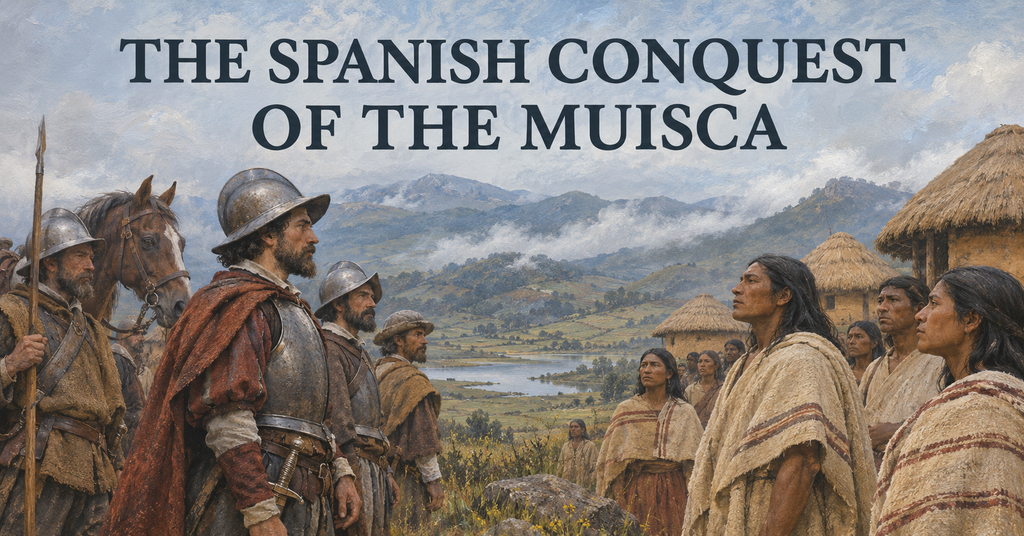
In April 1536, a lawyer turned soldier named Gonzalo Jiménez de Quesada led an expedition south from the small Spanish settlement of Santa Marta on the Caribbean coast. Within three years, the political order of the Muisca, one of the largest Indigenous societies in the northern Andes, had been broken. Their rulers were dead or captive, a temple at Sogamoso had burned, and a Spanish town stood on the savanna where Bogotá grows today.
This article follows that story year by year, using the dates that historians generally accept, and points out where the record is thin or one-sided. Nearly everything we know about these events comes from Spanish participants and later colonial writers, who had reasons to present the conquest in a flattering light. We write as an independent educational publisher, not on behalf of Muisca communities, many of whose members still live in and around Bogotá and continue to tell their own version of this history.
Table of Contents
The Highlands Before 1536
The Muisca occupied the high basins of the Eastern Cordillera, roughly the area of the modern departments of Cundinamarca and Boyacá, with a territory often estimated at around 22,000 square kilometers. It was fertile, cool country, dotted with lakes and wetlands and well suited to growing maize and potatoes.
Spanish writers called the political system a confederation, though it was less unified than that word suggests. The main powers were:
- The zipa, ruler of the southern domain, whose seat was Bacatá, near present-day Funza.
- The zaque, ruler of the northern domain, based at Hunza, today’s Tunja.
- The iraca, a religious leader centered on Sugamuxi, present-day Sogamoso.
- Tundama, an independent lord in the area of Duitama.
The zipa and zaque were rivals, and fighting between them was recent when the Spanish arrived. Population figures for this period are uncertain. Estimates range from about one million to more than three million people, and the honest answer is that nobody knows the exact number.
The March Up the Magdalena
Quesada set out in April 1536 with roughly 800 Spanish soldiers, along with horses and a large number of Indigenous people forced to carry supplies. Some went overland while others traveled in boats on the Magdalena River. The route took them through hot, flooded lowlands full of disease, hunger and attacks from local peoples who had no reason to welcome armed strangers.
The losses were enormous. By the time the expedition turned up the Opón River and began climbing toward the highlands, only about 166 Spaniards and 62 horses were left, according to commonly cited figures. Other counts put the number of survivors below 160. The death toll among the Indigenous carriers is not recorded with any precision, which is itself telling about whose lives the chroniclers counted. The expedition also brought dogs trained to attack people.
What kept them going was a sign of trade. In an abandoned hamlet the soldiers found salt formed into cakes, and a captured local man spoke of a rich country beyond the mountains. That was enough to push the exhausted men upward.
Into the Muisca Lands, 1537
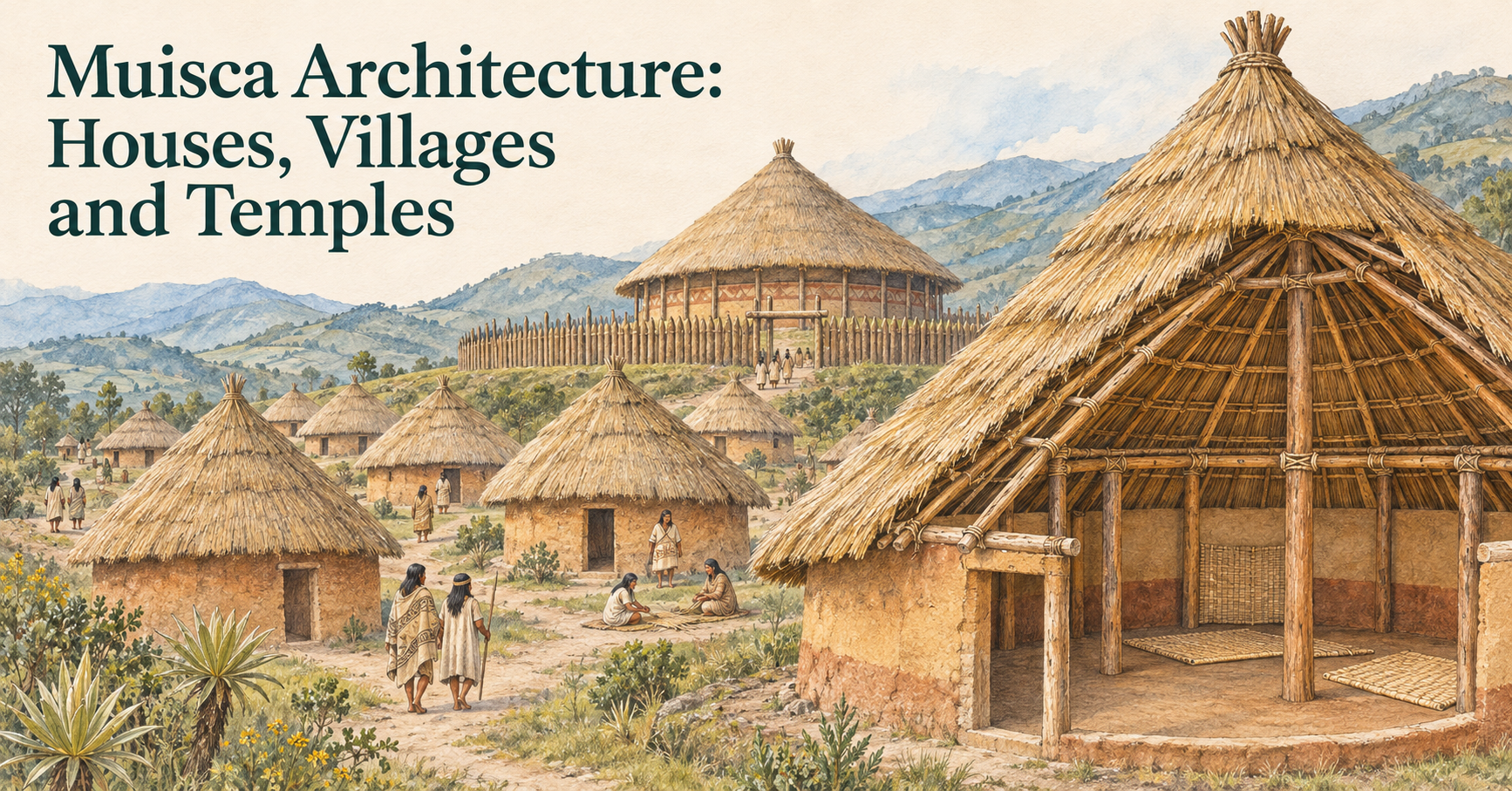
Early in 1537 the survivors reached the edge of the Muisca territory. They found villages of round houses, cultivated fields, roads and markets. The contrast with the lowlands made a strong impression. Looking out over the plain of Bacatá, Quesada called it the Valle de los Alcázares, the valley of the castles, after the large enclosed settlements in view.
The zipa at the time was Tisquesusa, who had ruled since about 1514. Faced with an unknown force carrying steel weapons and riding horses, he chose to withdraw rather than fight a pitched battle at Bacatá. He evacuated his main town and moved to a refuge near Facatativá.
The Spanish tracked him there and attacked at night. According to the traditional account, a soldier named Alonso Domínguez struck a fleeing man with his sword and took his fine mantle without realizing he had wounded the zipa himself. Tisquesusa escaped into the hills and died there of his injuries in 1537. His body was reportedly found much later when people noticed vultures circling over the spot.
Tunja and the Sun Temple
With the south in disarray, Quesada turned north toward Hunza. On 20 August 1537, his men reached the residence of the zaque, Quemuenchatocha, who had tried to buy time with gifts while moving valuables out of reach. The Spanish found him seated and took him prisoner. He was held at Suesca, later released, and died not long afterward at Ramiriquí. His nephew succeeded him according to Muisca inheritance rules, which passed power through the ruler’s sister.
From Hunza the Spanish pushed on to Sugamuxi, home of the iraca and its great Temple of the Sun. On the night of 4 September 1537, two soldiers, Miguel Sánchez and Juan Rodríguez Parra, entered the temple with torches to look for treasure. The building caught fire while they were collecting objects, and it burned to the ground. The usual telling describes the fire as accidental. Whether or not anyone meant to set it, the loss of the most important Muisca religious building to looting soldiers became a lasting symbol of the conquest.
Sagipa, Tocarema and the Search for Treasure
After Tisquesusa’s death, power in the south went to his brother Sagipa, a military leader. This broke with the Muisca custom of passing rule to the son of the ruler’s eldest sister, which suggests how badly the crisis had disrupted normal order.
Sagipa eventually made an alliance with the Spanish. On 20 August 1538, Spanish troops and Muisca warriors together defeated the Panche, long-time enemies of the Muisca from the warmer lands to the west, at the battle of Tocarema. The alliance did not protect him. The Spanish were convinced that Tisquesusa had hidden a great treasure, and they demanded that Sagipa hand it over. He was imprisoned, put on trial and tortured. He died in Spanish custody, most sources say in early 1539, and one account says boiling fat was used in the torture.
Founding Bogotá and the Three Captains
On 6 August 1538, Quesada carried out a first founding of a Spanish town on the savanna, which became Santa Fe de Bogotá. It lacked the legal formalities of the time: no officials were appointed and no lots were assigned. A second, legally valid founding followed on 27 April 1539.
That second ceremony happened partly because Quesada was no longer alone. Two other expeditions reached the savanna between late 1538 and early 1539:
- Sebastián de Belalcázar, coming north from Quito and Popayán with a fresh force and Indigenous allies from the southern Andes.
- Nikolaus Federmann, a German agent of the Welser banking house, which held rights in Venezuela, coming across the eastern plains.
Each man had a claim, and a fight was possible. Instead, the three leaders agreed to take their dispute to the Spanish Crown. They sailed for Spain in 1539. Belalcázar came away with the governorship of Popayán. Federmann gained little. Quesada faced legal trouble, lost the governorship of the new territory to others, and only returned to Bogotá years later. Meanwhile, Gonzalo Suárez Rendón founded Tunja on 6 August 1539 on the site of Hunza.
The Last Resistance
Muisca resistance did not end with the zipa and zaque. Tundama, the lord of the Duitama area, held out until late December 1539, when Spanish forces under Baltasar Maldonado defeated him.
In the north, the new zaque, Aquiminzaque, was accused of organizing a revolt. In early 1540, Hernán Pérez de Quesada, Gonzalo’s brother, who was in command while Gonzalo was in Spain, had him publicly beheaded in Tunja. Other caciques were executed afterward. Historians often treat his death as the end of the independent Muisca political order.
| Date | Event | Why it mattered |
|---|---|---|
| April 1536 | Quesada leaves Santa Marta with about 800 men | Start of the inland expedition |
| Early 1537 | About 166 Spaniards reach Muisca lands | Most of the force had died on the way |
| 1537 | Tisquesusa wounded near Facatativá, dies | Southern leadership thrown into crisis |
| 20 Aug 1537 | Zaque Quemuenchatocha captured at Hunza | Northern domain falls under Spanish control |
| 4 Sep 1537 | Sun Temple at Sugamuxi burns | Loss of the main religious center |
| 6 Aug 1538 | First founding of Santa Fe de Bogotá | Spanish town placed on the savanna |
| Early 1539 | Sagipa dies after torture | Last southern ruler gone |
| Early 1540 | Aquiminzaque beheaded in Tunja | End of independent Muisca rule |
After the Swords: Encomienda, Disease and Resguardos
The battles were short. The colonial system that followed shaped Muisca life for centuries.
Spanish settlers received encomiendas, grants that gave them the right to demand tribute and labor from Indigenous communities in return for a duty to protect them and instruct them in Christianity. In practice, the labor demands were heavy and the protection was weak.
Epidemic disease caused even more damage. Studies of the Tunja province estimate that the Indigenous population fell by somewhere between 65 and 85 percent between 1537 and 1636, with diseases brought from Europe as the main cause.
The Crown also gathered people into resguardos, communal lands set aside for Indigenous towns. These both protected some land and made people easier to tax and convert. In 1770, a royal order from Charles III banned the use of Indigenous languages in the region, speeding the loss of the Muisca language. Over the following centuries, many resguardos around Bogotá were dissolved and the land sold off.
None of this meant the Muisca vanished. In recent decades their descendants have rebuilt community councils in places such as Suba, Bosa, Cota, Chía and Sesquilé.
Who Wrote the Story
Reading about the conquest means reading Spanish sources, and it helps to know who they were.
- The Epítome de la conquista del Nuevo Reino de Granada is a short early account traditionally attributed to Quesada himself, though its authorship has been debated.
- Juan de Castellanos, a priest in Tunja, wrote the Elegías de varones ilustres de Indias, a verse chronicle of more than 150,000 lines whose first part appeared in 1589, drawing on veterans’ accounts and on writings by Quesada.
- Pedro Simón, a Franciscan, produced his historical notices in the early seventeenth century.
- Lucas Fernández de Piedrahita, a bishop born in Bogotá, published his general history in 1688.
All of these writers were Spanish or Spanish-educated Catholics. They tended to stress Spanish courage, explain away cruelty and describe Muisca religion as error. Some details, such as the exact words of a dying ruler, were likely invented or embellished. Historians cross-check these texts against legal records, tribute lists and archaeology, but there is no surviving written account of the conquest from the Muisca side.
Studying the Conquest Today
If you want to go deeper, several public institutions are good starting points.
- The Museo del Oro of the Banco de la República in Bogotá holds Muisca goldwork, the kind of objects the Spanish melted down in vast quantities.
- The Museo Nacional de Colombia covers the colonial period and its effects on Indigenous peoples.
- The Museo Arqueológico de Sogamoso, run by a public university, includes a reconstruction of the Sun Temple.
Travelers should remember that Bogotá sits at around 2,600 meters, and Tunja is higher still. Take it easy for the first day, drink water and carry travel insurance. A licensed local guide can add context that guidebooks miss. For structured study, university courses in Latin American colonial history, many of them online, cover the Muisca and the wider conquest, and reading Spanish opens up far more of the scholarship.
Quesada himself lived until 1579. Late in life he led another long, failed search for El Dorado, beginning in 1569, and returned with few survivors. He died in Mariquita, in present-day Tolima.
What the Victory Cost
Seen as a military campaign, the conquest of the Muisca was quick: a few hundred exhausted Spaniards, aided by horses, steel, disease and divisions among Muisca rulers, overturned a large society within about four years. Seen from the Muisca side, it was the start of a long loss of land, language and people that unfolded over centuries.
The story also shows how much depends on who holds the pen. The dates and names in this article come from men who took part in, or celebrated, the conquest. Their records are valuable, but they are not neutral. Listening to present-day Muisca communities, and to historians who read the sources critically, gives a fuller picture than any single chronicle can.
Conquest Questions, Answered Plainly
How many Spaniards reached the Muisca highlands?
Of the roughly 800 men who left Santa Marta in 1536, commonly cited figures say about 166 reached the highlands in early 1537, along with 62 horses. Some accounts give a slightly lower number. Hundreds of Indigenous carriers also died on the march, though their numbers were not recorded carefully.
Did the Spanish burn the Sun Temple on purpose?
The traditional account says two soldiers entered with torches to loot it on the night of 4 September 1537 and the fire started by accident. Since the story comes from Spanish sources, some caution is reasonable, but either way the temple was destroyed while it was being plundered.
Did the Muisca disappear after the conquest?
No. Their population fell sharply and their language went out of daily use, but descendants remained in the same region. Today, several Muisca councils are active around Bogotá, and thousands of people identify as Muisca in national census counts.