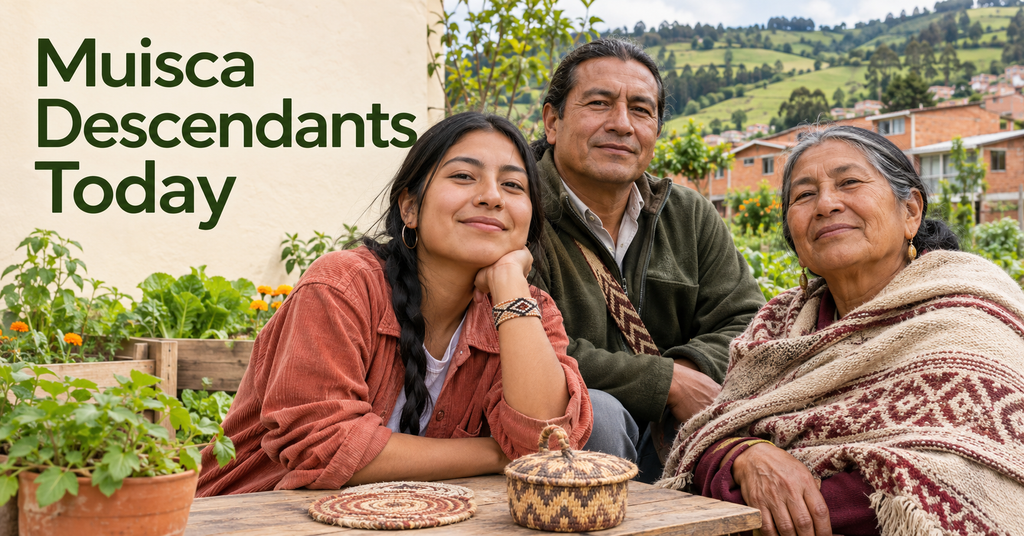
Ask many people in Colombia about the Muisca and you may hear them described in the past tense, as the people of gold rafts and El Dorado who disappeared after the Spanish conquest. That picture is wrong. Muisca families still live in Suba and Bosa inside Bogotá, and in towns on the savanna such as Cota, Chía and Sesquilé. They run their own councils, hold ceremonies tied to the solstices and equinoxes, teach children words of a language that fell silent more than two centuries ago, and take part in decisions about the city’s wetlands and hills.
This article is a practical overview of Muisca communities today: how their councils were rebuilt, what the census numbers do and do not show, what rights Colombian law recognizes, and how visitors and students can engage respectfully. We are an independent educational publisher. We do not speak for the Muisca, and anyone wanting to know a community’s position should go to its own council and spokespeople.
Table of Contents
A People Declared Gone, Yet Still Here
For much of the twentieth century, official histories and school textbooks treated the Muisca as a vanished civilization. The Ministry of Culture’s own profile of the Muisca people acknowledges that the group was at times considered extinct. The reasons are easy to trace. Conquest-era violence and epidemic disease cut the population sharply. A royal order in 1770 banned Indigenous languages in the region. Communal lands known as resguardos were broken up in the nineteenth and twentieth centuries, and families who had lost their land often stopped identifying publicly as Indigenous.
But identity did not vanish just because the paperwork did. Families kept surnames, farming knowledge, stories, healing practices and ties to particular hills and lagoons. In November 2026, during a district planning tour of sacred sites in Suba for children aged 8 to 12, a community member explained that the point was for the children to understand that the Muisca people still exist and are not extinct. That message sits at the center of almost everything Muisca organizations do today.
How the Councils Came Back
The modern revival is organized through cabildos, elected Indigenous councils that Colombian law recognizes as a form of community government. Muisca councils began to be rebuilt from 1989 onward. A 1999 forum titled “Los muiscas: un pueblo en reconstrucción” (The Muisca, a people in reconstruction) helped communities plan how to organize. Then, from 20 to 22 September 2002, the first General Congress of the Muisca People met in Bosa and created the Cabildo Mayor del Pueblo Muisca, an umbrella body that joined Colombia’s National Indigenous Organization, known as ONIC.
The founding communities were Suba and Bosa in Bogotá, along with Cota, Chía and Sesquilé in Cundinamarca. The Cabildo Mayor also supports Muisca groups in Ubaté, Tocancipá, Soacha, Ráquira and Tenjo. Its work covers education and culture, health, territory and environment, relations with other peoples, and language.
Suba
The Cabildo Indígena Muisca de Suba was created on 25 January 1991 and is one of the oldest in the country. Public radio reporting describes about 2,500 families, roughly 8,000 people, many tied to neighborhoods such as Suba Rincón, Suba Centro, Tuna Alta and El Salitre. The community traces its land losses to the dissolution of the Suba resguardo in 1878 and to fraudulent sales during the urban boom of the 1970s and 1980s. Today it has a council of elders of about 30 members, a youth guard and a replica of a traditional Muisca kitchen, called a fuechy, at its headquarters. Leaders have said publicly that they lack a building of their own and depend on projects and donations.
Bosa
Bosa, in the southwest of Bogotá, hosted the 2002 congress and has an active council. According to Bogotá’s district government, Suba and Bosa are the two Muisca cabildos in the capital recognized by the Ministry of the Interior.
Cota, Chía and Sesquilé
Cota has a distinctive history. Community members bought back land in 1916 and later rebuilt a resguardo on it. Official recognition came under the 1991 Constitution, was withdrawn by the state in 1998 and was restored in 2006. Cota is also home to Jizcamox, described as the only public school teaching the Chibcha language, with around 150 children. Chía and Sesquilé, north and northeast of Bogotá, maintain their own councils and sacred sites; Sesquilé’s territory includes the Guatavita lagoon.
| Community | Where it is | A detail worth knowing |
|---|---|---|
| Suba | Northwest Bogotá | Council created 25 January 1991; around 2,500 families reported |
| Bosa | Southwest Bogotá | Hosted the 2002 congress that formed the Cabildo Mayor |
| Cota | West of Bogotá | Resguardo recognition withdrawn in 1998, restored in 2006 |
| Chía | North of Bogotá | Town named after the Muisca moon figure |
| Sesquilé | Northeast of Bogotá | Territory includes the Guatavita lagoon |
| Cabildo Mayor | Regional umbrella | Founded September 2002; member of ONIC |
Counting a Living People
Numbers are one of the hardest parts of this story. Colombia’s census relies on self-identification: people are asked whether they belong to an Indigenous people and, if so, which one.
- The 2005 census counted 14,051 people who identified as Muisca. About 41 percent lived in Bogotá and 42 percent elsewhere in Cundinamarca, and nearly 73 percent lived in urban areas, far above the national average for Indigenous people.
- The 2018 census recorded 11,265 people identifying as Muisca.
These figures should be read with care. The 2018 census faced wide criticism for coverage problems in several groups, and urban Indigenous people are often harder to count because they live in mixed neighborhoods and may not be asked the question in a way that feels relevant. Council membership figures, like the 8,000 or so reported for Suba alone, suggest the census count may be low, but the two measures use different definitions, so they cannot simply be compared. The safest statement is that thousands of people identify as Muisca today, and the true number is uncertain.
Rights Under the 1991 Constitution
Colombia’s 1991 Constitution was a turning point for Indigenous peoples. It recognizes and protects the country’s ethnic and cultural diversity, treats the languages of ethnic groups as official in their territories, and allows Indigenous authorities to exercise their own forms of justice within limits. In the same year, Colombia approved International Labour Organization Convention 169 through Law 21 of 1991, which commits the state to consult Indigenous peoples on measures that affect them directly.
For the Muisca, these protections matter in specific ways. Formal recognition of a cabildo by the Ministry of the Interior affects whether a community can be consulted, receive certain public resources and run education or health programs. Not every council has that status. Public reporting from Suba noted that of 14 Indigenous cabildos of various peoples in Bogotá, only five held legal recognition from the ministry. Urban communities face an added difficulty: the law was largely built around rural territories, while many Muisca live in apartment blocks and old village centers swallowed by a city of millions.
Waking Muysccubun
The Muisca language, often called Muysccubun or Chibcha, stopped being spoken as a community language by the late eighteenth century. It belongs to the Chibchan family, and its closest living relative is U’wa. What survives comes mainly from colonial priests’ work. The best-known source is a grammar by Fray Bernardo de Lugo printed in Madrid in 1619, which even introduced a special letter for a vowel sound Spanish lacked.
Revival is under way, but it is contested. At the Universidad Nacional, anthropologist Diego Fernando Gómez has argued that comparative linguistics can reconstruct enough of the language to bring it back into use. Linguist Olga Ardila has argued that any revived form would really be a new variety she calls “Neo-Muysca.” Communities have pushed ahead regardless. In Suba, children learn words and phrases, and the council has worked with primers, apps and university researchers. Leaders there have also said a longer, funded plan is still needed.
Some Muisca words never left everyday Spanish in the Bogotá region. Changua, a breakfast soup of milk and egg, cuchuco, a grain soup, and chucua, a local word for a marshy wetland, are often cited examples.
Ceremony, Calendar and Craft
Muisca communities organize part of their year around the sun. In Suba, four festivals mark the solstices and equinoxes and track planting and harvest, including a maize festival in June. Weaving workshops keep textile skills alive, and gatherings in ceremonial spaces bring elders and young people together. Knowledge keepers, often called sabedores, teach history and lead cleansing practices.
Not all of this is meant for outsiders. Some events are public and welcome visitors. Others are closed, and the line between them is the community’s decision.
Hills, Wetlands and the City Plan
For Muisca councils, territory is not only land they own. It includes hills, lagoons, wetlands and páramos they regard as sacred, many of which now sit inside or beside urban Bogotá. The city’s 2023 announcement named the Tibabuyes and Chiguasuque lagoons among the places involved.
In June 2023, the district announced that a map of Muisca sacred sites drawn up by the Suba and Bosa councils would be part of its land-use plan, Bogotá Reverdece 2022–2035. The plan’s text commits the city to work toward recognizing and caring for that system of sacred sites. Community members have pointed out that recognition on paper does not automatically stop construction, pollution or illegal dumping. Pollution of the Bogotá River remains a sore point for Suba’s council, which sees the river’s condition as a shared responsibility of everyone in the city.
Being a Respectful Visitor or Learner
Interest in Muisca culture has grown, and with it a market for “ancestral” experiences around Bogotá. Some are run by communities themselves. Others use Muisca imagery with no community involvement. A few practical guidelines help:
- Ask who is behind it. If an event or tour claims Muisca content, ask whether a recognized council or named community members are involved.
- Do not photograph ceremonies without permission. Ask first, and accept a no.
- Buy crafts directly. Woven goods and pottery bought from makers or community stalls put money where it helps.
- Think about museum displays. Some museums hold Muisca human remains. Many Indigenous people object to ancestors being shown as exhibits, and debates over return and reburial are ongoing. Visit thoughtfully, and do not photograph remains.
- Prepare for the altitude. Bogotá sits at about 2,600 meters, and sacred lagoons such as Guatavita are higher. Pace yourself, drink water and carry travel insurance.
For deeper study, university anthropology courses on Indigenous Latin America, many available online, give useful background. Learning Spanish is close to essential, since most writing by and about Muisca communities is in Spanish.
Roots Under the Pavement
The Muisca story today is not about a lost civilization that left behind gold and place names. It is about families in Suba, Bosa, Cota, Chía and Sesquilé who have spent more than three decades rebuilding councils, reclaiming a language from colonial grammars and pressing a capital city of millions to protect wetlands and hills that matter to them. They have won real gains, from legal recognition to a place in Bogotá’s land-use plan, and they still face basic problems such as a lack of land and stable funding.
For outsiders, the most useful shift is simple: stop speaking of the Muisca only in the past tense. Visit the museums, read the history, but also listen to the people who carry the name now.
Common Questions About Muisca Communities Now
Do people still speak the Muisca language?
There are no native speakers today; the language stopped being spoken as a community language by the late 1700s. Communities in Cota, Suba and elsewhere are teaching reconstructed words and phrases, especially to children, though linguists disagree about how closely a revived form can match the original.
How many Muisca are there today?
The 2018 national census counted 11,265 people who identified as Muisca, down from 14,051 in 2005. Council membership figures suggest the real number may be higher, so the census total is best treated as a minimum rather than a precise count.
Can visitors attend Muisca ceremonies?
Some public festivals, such as those marking solstices and equinoxes, may welcome visitors, but each council decides. The respectful approach is to contact the community directly, ask what is open, follow any rules about photographs and clothing, and never assume an event is public.