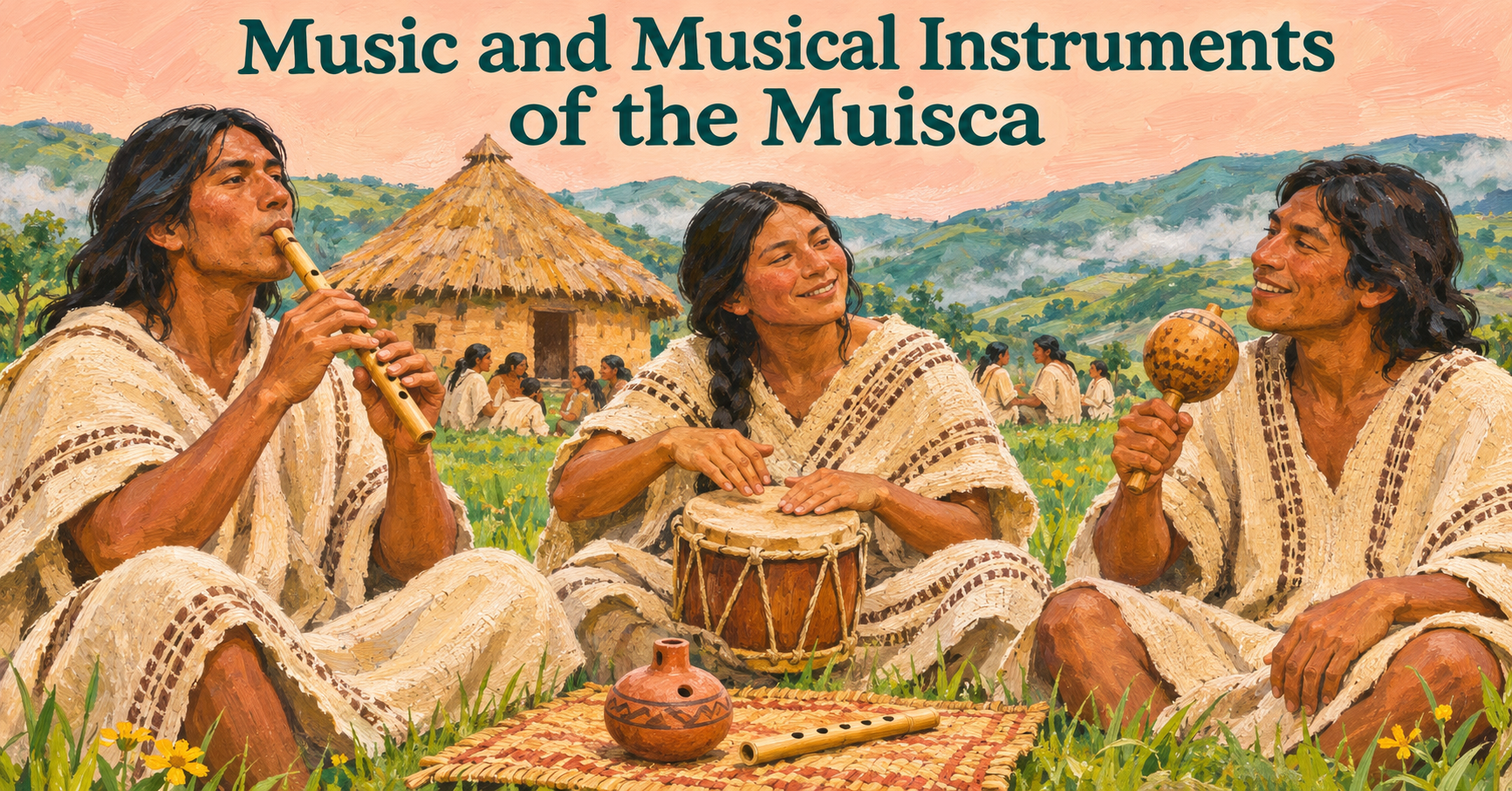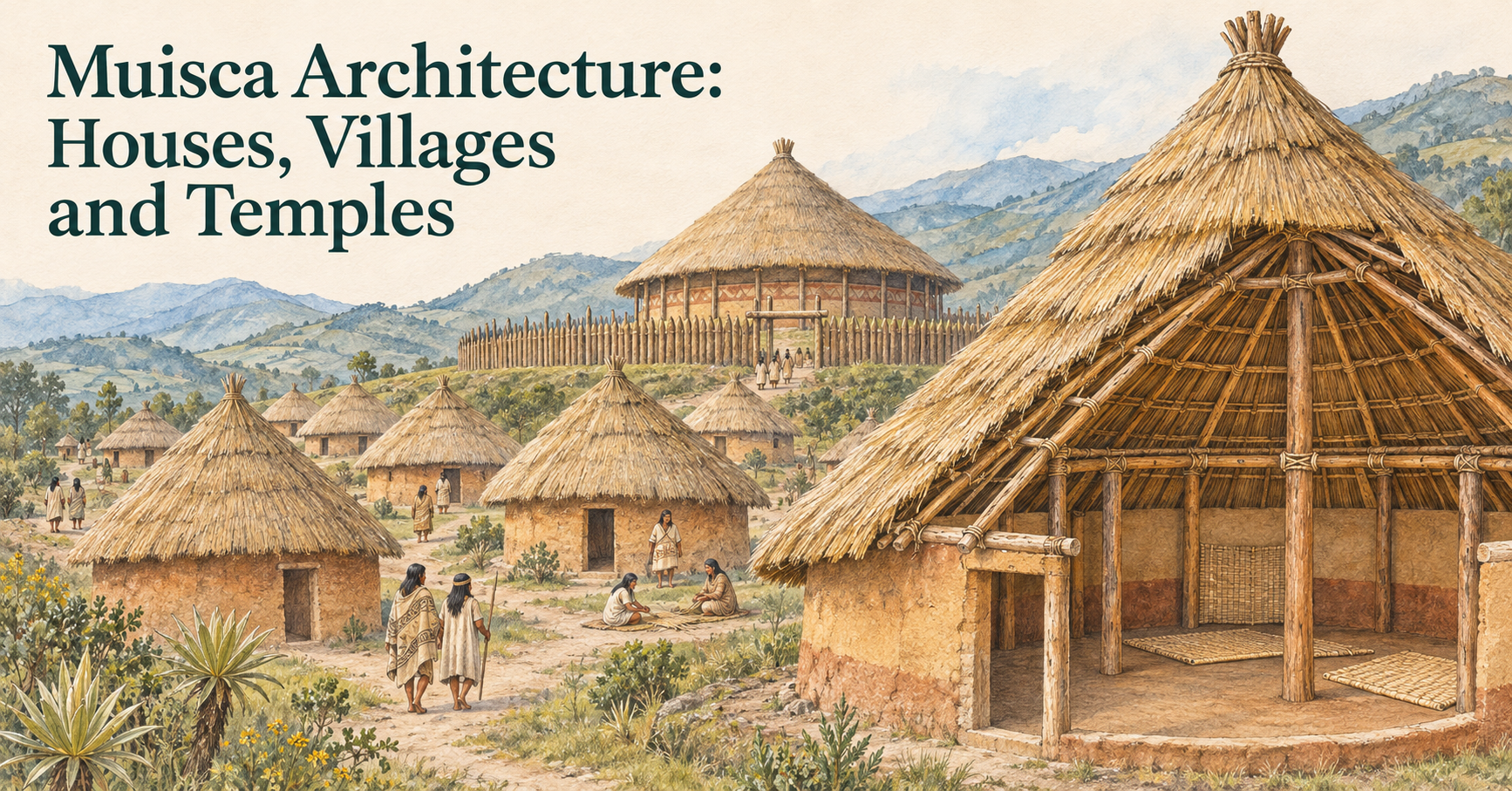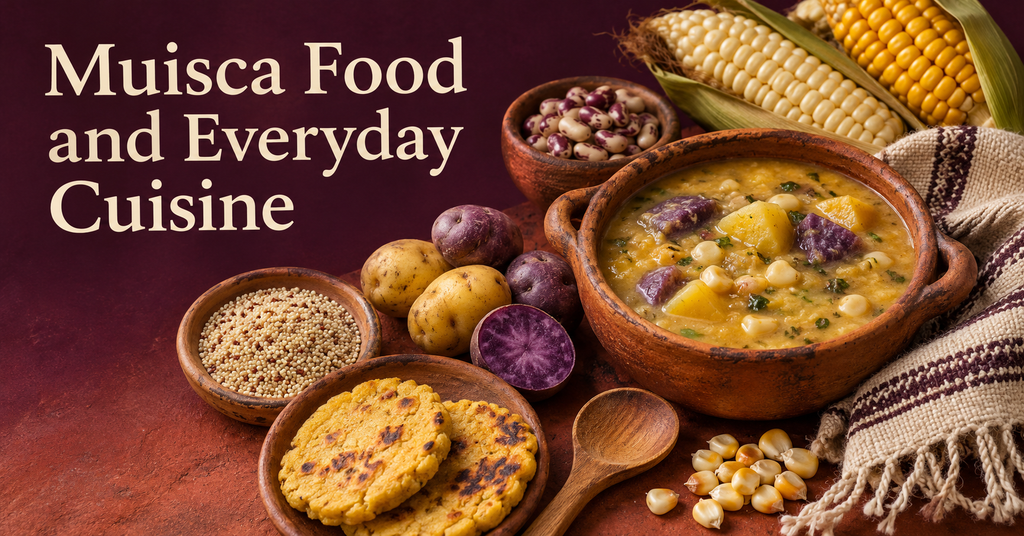
Picture a Muisca household on the Bogotá savanna on an ordinary evening around the year 1400. Someone is roasting ears of maize over coals. A pot holds a stew of tubers with a sharp kick of ají. Guinea pigs scurry in a corner of the house, waiting for a feast day. A jar of fermented maize drink sits ready for guests. Nobody uses a fork; people sit on the ground and eat with their hands from leaves or clay bowls.
That scene is a reconstruction, but each part of it rests on evidence: excavated bones and seeds, chemical studies of human remains, colonial descriptions and crops that highland farmers still grow. This article walks through what the Muisca ate, how they grew and prepared it, who got the best cuts, and which flavors survive on Colombian tables. As an independent educational publisher, we describe the historical record; we do not speak for Muisca communities, who keep their own food knowledge and ceremonies.
Table of Contents
A Farming People at 2,600 Meters
The Muisca lived on the cool high plateau of present-day Cundinamarca and Boyacá, the Altiplano Cundiboyacense. Frost, heavy seasonal rain and wetlands shaped what could grow. Farmers responded with raised fields, called camellones in Spanish, built up in rows with drainage channels between them. Those ridges kept roots out of waterlogged soil and may have helped protect crops on frosty nights.
Because the highlands range from cold páramo edges down to warmer slopes within a day’s walk, families often worked plots at different elevations. That spread reduced the risk of one bad season and let households grow a wider mix of crops.
Maize at the Center
Maize was the staple and held sacred value. The Muisca language, Muysccubun, reportedly had many words for maize and its parts, a common sign of how central a food is to a culture. Early maize in the region has been dated at Zipaquirá to around 150 BCE and at Tequendama to about 275 BCE, with some claims of much older traces that remain debated.
Ways to Eat It
- Fresh off the plant or roasted on the cob over a fire.
- Toasted or popped kernels, an easy portable food.
- Ground into dough and cooked as flat cakes, the ancestors of the arepa.
- Fermented into chicha, a lightly alcoholic drink central to hospitality and ritual.
Summaries of Muisca food history suggest arepa-like maize cakes appear in the highlands around three thousand years ago. That date reflects broad archaeological trends, not a single dated griddle, so treat it as approximate.
Tubers, Grains and Peppers
Potatoes come to mind first for many people thinking of Andean food, but in Muisca diets they seem to have been one crop among many rather than the dominant one. A wide set of roots and tubers filled out meals.
The Andean Tuber Trio
Three tubers matter especially because they are still grown in Boyacá today. Cubio is Tropaeolum tuberosum, known as mashua elsewhere in the Andes. Ibia is oca, Oxalis tuberosa. Ruba is ulluco, Ullucus tuberosus. A 2017 study by N. L. Clavijo Ponce in the Javeriana journal Cuadernos de Desarrollo Rural traced how these crops persisted in Turmequé and Ventaquemada from pre-Hispanic times to the present, mostly in family gardens for home use. The study notes they were roasted in ashes, cooked in soups and stews, and stored for later.
Other Staples
- Quinoa, a protein-rich seed crop long grown in the Andes.
- Beans, which pair well nutritionally with maize.
- Arracacha, a starchy root with a flavor somewhere between celery and carrot.
- Yacón, a crisp, sweet root eaten raw, usually with a little salt.
- Yuca and sweet potato from warmer zones.
- Squash and ají, the chili pepper, which the Muisca reportedly called quybsa.
Fruit From Many Altitudes
Fruit lists for the region include uchuva (cape gooseberry), lulo, several passion fruits, tree tomato, guava, avocado and cherimoya. Many of these grow below the coldest part of the plateau, so they arrived through local exchange or from family plots on lower slopes.
| Food | Muisca-era use | Where it shows up today |
|---|---|---|
| Maize | Roasted, popped, ground into cakes, fermented | Arepas, mazamorra and chicha across the highlands |
| Cubio | Roasted in ashes, soups, stews | Family gardens and local markets in Boyacá |
| Ruba (ulluco) | Cooked tuber in mixed dishes | Traditional soups in Cundinamarca and Boyacá |
| Guinea pig | Raised at home as a main meat | Eaten in parts of the Andes, especially in the south of Colombia |
| Deer | Hunted; reportedly restricted to privileged people | Rarely eaten today; hunting is regulated |
| Lake fish | Caught in rivers and lagoons | The native capitán is far less common than it once was |
| Salt | Boiled from local brine springs | Zipaquirá and Nemocón remain salt towns |
Meat, Fish and Who Ate What
A study of skeletons and mummies from the region, summarized in reviews of Muisca diet, suggests roughly 60 percent of food came from plants and around 40 percent from animal sources, especially fish. Those proportions vary by site and period, but they caution against imagining a purely vegetarian people.
Guinea Pig: The Household Animal
Guinea pig, called curí in Colombian Spanish, was the most important domesticated meat. In her 1998 study of Muisca fauna, archaeologist Anne Legast reported at least 30 individuals at the Nueva Fábrica site, where the young age and similar size of the animals pointed to domestic raising. At a Tunja site, guinea pig made up around 15 percent of the vertebrate remains.
Deer: Meat With Meaning
Deer bones were the most common animal remains in many excavations, making up about 80 percent of the vertebrate material at that same Tunja site. Legast cites Fray Pedro Simón’s claim that deer meat could only be eaten by people granted the privilege by caciques, while rabbit, guinea pig and birds were open to everyone. Simón was a seventeenth-century Franciscan writing well after the conquest, so the rule may be simplified. Still, archaeological work summarized by historian Juan F. Cobo Betancourt links deer meat and chicha preparation to elite dwellings, which fits the idea that venison marked status.
Fish From Lakes and Rivers
Fish remains, including the native capitán, appear in excavations. Lakes and rivers on the plateau supplied local catches, and some fish arrived through trade from the Magdalena valley and the eastern plains. Salt from Zipaquirá and Nemocón helped dry and preserve both fish and meat.
Chicha: The Drink That Held Gatherings Together
No food tells more about Muisca social life than chicha. Made by fermenting maize, it was served in large quantities at feasts, during communal work and in religious ceremonies. Colonial records of a 1563 gathering at Ubaque, east of Bogotá, describe the host supplying abundant chicha to guests who said they had come to celebrate and drink. Hosting with chicha built obligations; a leader who fed and poured generously could call on people’s labor later.
A Century of Suspicion
Chicha outlived the conquest and stayed popular in Bogotá and rural towns for centuries, but authorities and industrial brewers long attacked it as unhygienic. Colombia’s Law 34 of 1948, issued on 5 November that year, required fermented drinks from maize and other grains to be pasteurized, capped at 4 percent alcohol and sold in sealed individual glass containers from January 1949. Homemade chicha could not meet those terms, so the law worked as a practical ban on traditional chicherías. Some accounts tie the crackdown to the unrest after the assassination of Jorge Eliécer Gaitán in April 1948.
Chicha never disappeared. It remained in homes and neighborhoods, and Muisca communities serve it at their own ceremonies today. If you are offered some at a community event, accept or decline politely and follow your hosts’ customs.
How Meals Were Cooked and Shared
Cooking happened over open fires and in simple ovens, and the region’s coal deposits provided fuel in some areas. Clay pots handled stews and porridges; griddles and hot stones handled maize cakes. Summaries of Muisca dining describe people sitting on the ground, eating with their hands and using leaves or ceramic dishes rather than cutlery.
Storage and the Farming Year
A highland harvest has to last. Dried maize and beans keep for months, and Legast’s review of Muisca fauna notes that staples such as these were stored inside houses alongside other provisions. Tubers were kept for later use too, and the Clavijo Ponce study describes traditional ways of holding cubios after harvest. Salted and dried fish or meat added protein in lean weeks. That planning mattered because rain on the plateau falls in two main seasons, and frost can strike crops without much warning.
A Shared Pot, Not a Menu
Meals were probably simple and repetitive by modern standards: a porridge or stew built on maize and tubers, seasoned with ají and salt, with meat added when available. Variety came from the season and from trade rather than from a long list of dishes. Feasts were the exception, when hosts showed generosity through plentiful chicha and, for elite households, venison.
Food was also religious. Offerings of food were among the most common gifts to deities, and agricultural feasts marked digging, planting and harvest. Eating, working and worship overlapped constantly.
After the Conquest
Spanish rule changed highland food quickly. Wheat, barley, cattle, sheep, pigs and chickens arrived, and colonial landholders took prime land. Studies summarized in reviews of Muisca diet report a sharp drop in meat access after the conquest, though one set of findings from Tunja found no signs of widespread malnutrition. Diets shifted rather than collapsed, and many Indigenous crops held on in household gardens.
Ajiaco and Other Descendants
Bogotá’s famous ajiaco, a chicken and potato soup, is often credited to Muisca roots. A Canal Trece history of the dish says the Muisca made a soup of potato, onion and maize, and that chicken, cream and capers came later. It notes that guascas, the herb that gives ajiaco its aroma, appears in mid-nineteenth-century texts, and that the earliest documented recipe with cream dates from 1937. Since no pre-Hispanic recipe survives, it is fairest to call ajiaco a colonial and modern dish built on Indigenous ingredients.
Tasting the Highlands Responsibly
- Visit public markets in Bogotá and Boyacá towns to see cubios, rubas, ibias, arracacha and uchuvas sold side by side.
- Learn the context first. The Museo del Oro and the Museo Nacional in Bogotá show ceramic vessels and offerings that connect food to ritual.
- Respect the altitude. At around 2,600 meters, go easy on alcohol, including chicha, on your first days, and carry travel insurance that covers medical care.
- Use licensed guides for rural visits and farm stays so that you arrive with permission and context.
- Study further. Courses in archaeology, food history or agroecology cover Andean crops in depth, and reading Spanish gives access to most of the research.
Roots That Still Feed Colombia
Muisca cuisine was built on maize, a rich set of highland tubers, beans, quinoa and peppers, with guinea pig, fish and, for some, deer adding protein. Salt from local springs preserved and seasoned it, and chicha bound people together at every important moment. Spanish rule rearranged that system, and a 1948 law tried to push chicha out of public life, yet the crops and habits endured.
Today cubios in a Boyacá garden, an arepa on a Bogotá street corner and a gourd of chicha at a Muisca ceremony all carry that long history forward. Tasting them with curiosity and respect is a good way to understand the people who first grew them.
Kitchen Questions About the Muisca
Did the Muisca eat potatoes?
Yes, but potatoes appear to have been less central than in some southern Andean cultures. Maize was the main staple, and other tubers, including cubio, ibia and ruba, plus arracacha and yacón, filled out the diet.
Was chicha really banned in Colombia?
In practice, yes for a long time. Law 34 of 1948 required fermented grain drinks to be pasteurized and sold in sealed individual glass containers, which traditional producers could not do. Chicha survived informally and is still made today.
Is ajiaco a Muisca dish?
Partly. It draws on Indigenous ingredients such as potatoes and maize, and some histories credit the Muisca with an early version. Chicken, cream and capers arrived after the conquest, so the modern recipe is a blend shaped over centuries.