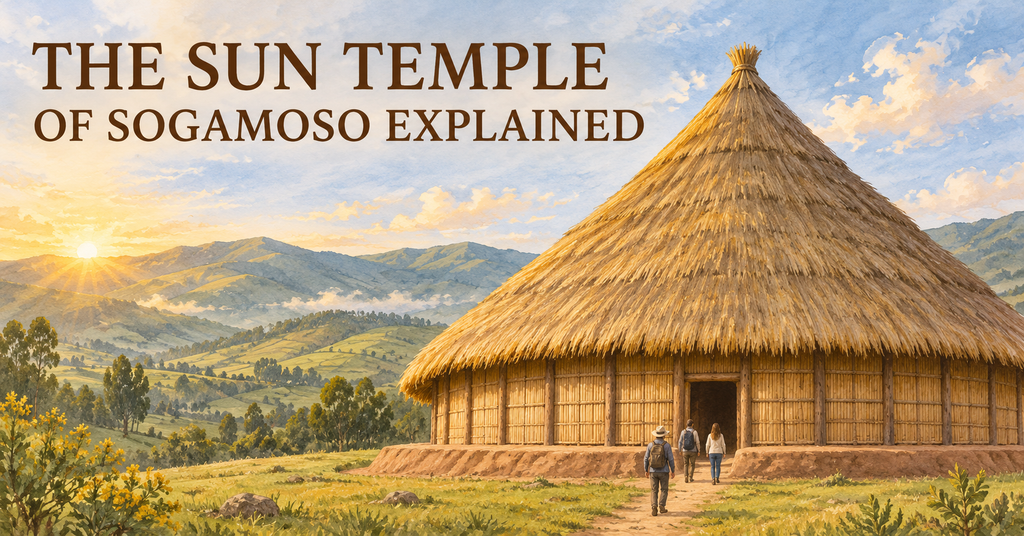
In the city of Sogamoso, in Colombia’s Boyacá department, a tall round building with a thatched cone for a roof stands on the grounds of an archaeology museum. It is a reconstruction of the Templo del Sol, the Sun Temple, which Muisca people regarded as one of their holiest places before Spanish soldiers burned it in September 1537. Visitors often assume they are looking at the original. They are not, and understanding the difference is the best way to appreciate the site.
This explainer focuses on that one place in depth: who ran it, what it was for, how it was lost, how an archaeologist spent decades rebuilding it and how its solstice celebrations have returned. We are an independent educational publisher and do not speak for Muisca communities. Much of what is known comes from Spanish chronicles written by the conquering side, so we flag where a detail rests on those accounts, on legend or on archaeology.
Table of Contents
Sugamuxi, the Iraca and a Sacred Valley
Before the conquest, Sogamoso was known as Sugamuxi or Suamox. It was not a capital in the political sense, like Bacatá in the south or Hunza (Tunja) in the north. Its importance was religious. The local ruler, called the iraca, served as both political leader and high priest, and his authority was respected across Muisca territory.
The way an iraca was chosen was unusual. According to historical reconstructions, the caciques of Gámeza, Busbanzá, Pesca and Toca acted as electors, and candidates usually came in turn from Tobasía or Firavitoba. If the electors deadlocked, the tundama, ruler of Duitama, could step in. Muisca tradition held that the line of iracas descended from Idacansás, a figure instructed by the civilizing hero Bochica, which gave Sugamuxi a special claim to sacred knowledge.
The last iraca at the time of the conquest is remembered by the name of his territory, Sugamuxi. He had succeeded a ruler named Nompanim, stayed neutral in the wars between the zipa and the zaque, was baptized as Don Alonso and died in 1539.
What the Temple Was Built to Do
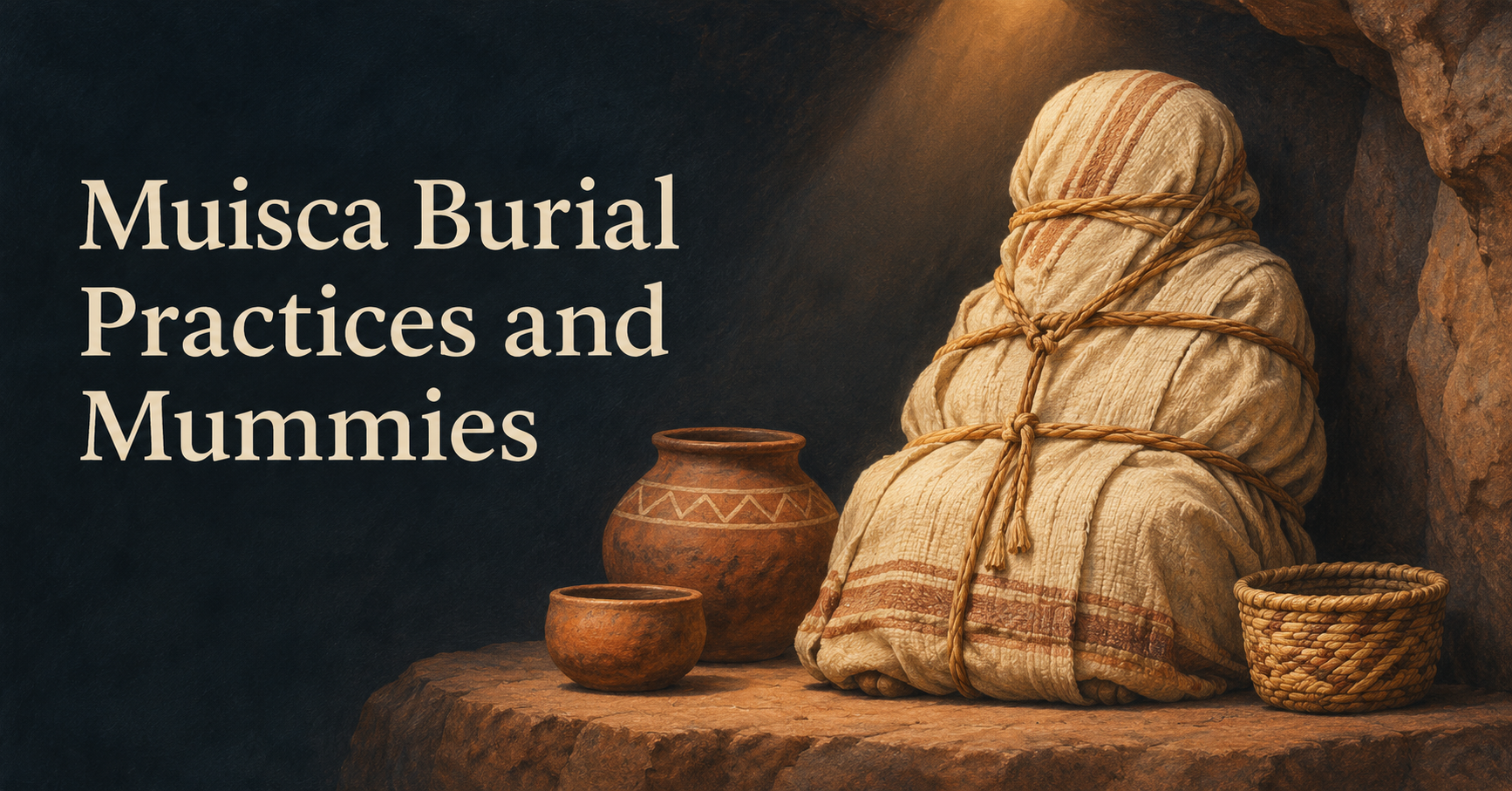
The Templo del Sol honored Sué, the sun. It was a place of offering, pilgrimage and burial. Accounts mention gifts of gold, emeralds, cotton, salt, maize and woven mantles, and golden plates and small votive figures called tunjos reportedly decorated the outside. Inside, the temple kept the mummified bodies of important caciques and priests, which made it a house of ancestors as well as a shrine.
Pilgrims came from far beyond the valley. Lucas Fernández de Piedrahita, a seventeenth-century bishop and chronicler, described a procession of the zipa traveling from Bacatá to Suamox with offerings for a great festival. Even if his account is embellished, it shows that the sanctuary drew rulers and ordinary people from rival parts of the Muisca world, which helps explain why the iraca could stay neutral in their conflicts and still keep everyone’s respect.
A sacred spring called Conchucua lay close to the sanctuary. The name survives today in the area around the museum, and it matters for the modern ceremonies described below.
The Building, as Sources Describe It
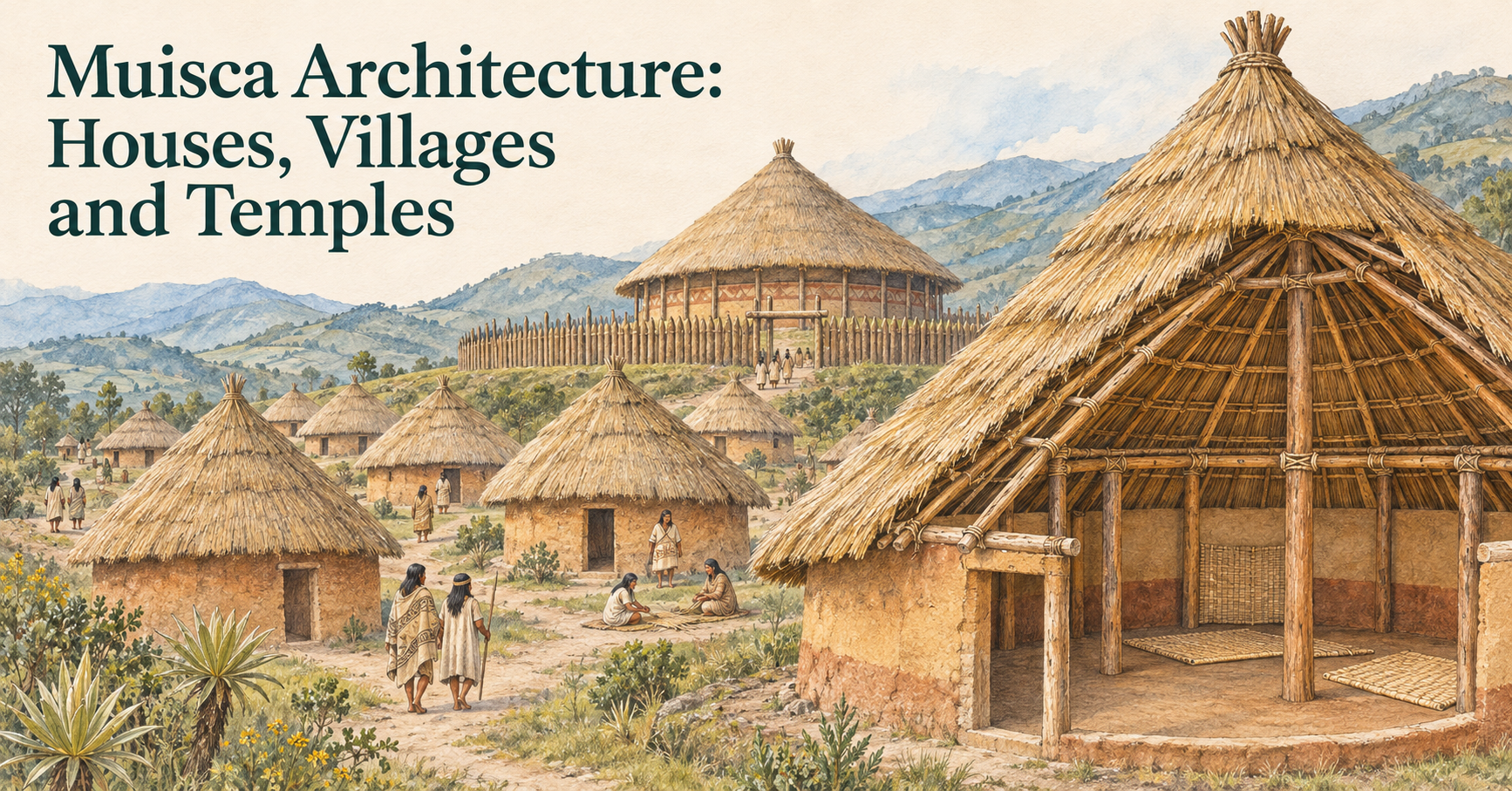
No one has a plan of the original, so its form is pieced together from chronicles, excavation and comparison with other Muisca buildings. The broad picture is consistent:
- A large round structure with walls of poles and clay and a roof of reed.
- Rings of wooden columns, with timber reportedly brought from the Casanare lowlands to the east.
- No windows, which made the interior very dark.
- Walls or interior surfaces covered in woven mats, and a floor strewn with esparto grass.
- Entrances facing east and west, oriented toward sunrise and sunset.
Some local accounts credit the legendary ruler Goranchacha with ordering a monumental bohío full of gold here, and some say its stones and columns were hauled from distant places. These stories are worth knowing but should be read as tradition, not as a construction record. Goranchacha is more firmly tied in the sources to a separate temple in Tunja.
The Night of 4 September 1537
Gonzalo Jiménez de Quesada’s expedition reached Sugamuxi in late August or early September 1537, after it had already plundered other Muisca settlements. According to the chronicle tradition, Quesada chose to wait until morning before entering the temple and removing the iraca. That night, two soldiers, usually named as Miguel Sánchez and Juan Rodríguez Parra, went inside with torches to search for gold. They found ornaments and mummies, and in the dark, with dry grass underfoot, fire caught.
Whether the burning was an accident or the result of reckless looting depends on which telling you follow. Most chronicles call it accidental: torches set down or brushed against the mats. Some modern authors stress greed as the real cause, since the men were there to strip the shrine. Both framings agree on the outcome. The temple was destroyed, and Muisca people who tried to resist were unable to stop it.
Two further details are often repeated but are hard to confirm. One holds that the fire smoldered for more than a year. Another says a great golden image of the sun disappeared and may have been thrown into Lake Tota. Treat both as part of the legend that grew around the event.
The main milestones in the temple’s story are summarized here.
| When | What happened | How solid the evidence is |
|---|---|---|
| Before 1537 | Temple serves Sué, the iraca and ancestral mummies | Chronicles and later Muisca tradition |
| 4 Sept 1537 | Soldiers searching for gold with torches start the fire | Chronicle accounts; cause debated |
| 1539 | Death of Sugamuxi, the last iraca, baptized Don Alonso | Colonial records summarized by historians |
| 1942 | Eliécer Silva Celis begins searching near Conchucua and finds a cemetery | Excavation records and biographies |
| 1940s–1950s | Museum founded; most sources give 1942, one gives 1952 | Sources differ on the exact year |
| Since 1953 | Museum curated by the UPTC, a public university | Museum histories |
| 2007 | Reconstruction reported complete, the year Silva Celis died | Colombian public media report |
Silva Celis and the Long Rebuild
The modern story begins with Eliécer Silva Celis, a Boyacá-born archaeologist and anthropologist. In 1942 he started looking for the remains of the temple in the Monquirá area of Sogamoso, near the old Conchucua spring, and uncovered a Muisca cemetery. From that work he identified what he believed was the original location and set out to rebuild the sanctuary on the spot.
He founded the Museo Arqueológico de Sogamoso on those same grounds. Most sources date the founding to 1942, though at least one gives 1952, so it is fair to say it opened in the 1940s or early 1950s. The Universidad Pedagógica y Tecnológica de Colombia, a public university based in Tunja, has been responsible for it since 1953. Silva Celis kept working on the reconstruction for the rest of his life, and Colombian public media report that it was finished in 2007, the year he died. His daughter, anthropologist Margarita Silva, later became the museum’s director.
What You See Now
The rebuilt temple rises about 18 meters. Its circular frame is supported by wooden beams around the edge, under a straw roof. Symbols painted inside the dome refer to the creation of the world by Chiminigagua, the Muisca source of light and creation. Small openings in the walls act as a solar calendar: according to the museum, sunlight falls directly on the central pillar each year around 22 December.
The Fiesta del Huan and the December Solstice
The temple is not only a museum piece. Around the December solstice, a celebration known as the Fiesta del Huan, also called Zocán, takes place at the site. It runs through the night of 21 December until sunrise in the Conchucua area. Descriptions say the event closes when the sun stands over the tip of the temple’s conical roof, marking the end of a solar cycle, which the museum has described as the departure of an old, tired sun.
Older accounts of the festival mention purification with tobacco smoke by a priest and dancing around a central post, with chicha shared among participants. The modern gathering draws on those descriptions and on the revival of Muisca spirituality. If you attend, remember that for many participants this is ceremony rather than spectacle. Ask before photographing people, follow the organizers’ instructions and stay sober and quiet during ritual moments.
Reading the Reconstruction With Care
A reconstruction is an argument made in wood and straw. It reflects the evidence its builder had and the choices he made where evidence ran out. The height, the decoration and the interior layout are informed estimates, and specialists may disagree with some of them. That does not make the building less valuable. It makes it a teaching tool that invites questions.
The Spanish sources need the same scrutiny. Chroniclers such as Pedro Simón and Lucas Fernández de Piedrahita wrote long after 1537 and framed Muisca religion as idolatry to be replaced. Details about the temple’s riches may be inflated, and the soldiers’ version of the fire may soften their responsibility. Archaeology keeps adding to the picture: in 2015, a grave was found on the museum grounds, a reminder that the site is also a burial place.
Planning a Respectful Visit
The Museo Arqueológico de Sogamoso is at Calle 9ª No. 6-45, a short ride from the city center. Its collection holds about 4,000 objects from the Muisca and earlier Herrera periods, covering ceramics, goldwork, textiles and burial practices, including a section on mummies. Check current hours with the museum or the municipality before you go, as they can change around holidays.
- Altitude: Sogamoso sits at about 2,500 meters. If you are coming from the coast, allow a day to adjust and keep a warm layer handy, since mornings are cold.
- Guides: A licensed guide or the museum’s own staff can explain the difference between original finds and reconstructed elements, which makes the visit far more meaningful.
- Insurance: Travel insurance with medical cover is worth having for any trip through Boyacá’s highlands and rural roads.
- Human remains: Follow posted rules about photography in the mummy section, and remember these are the bodies of real people whose descendants live nearby.
- Combining stops: Lake Tota, the region’s great sacred lake, and the Goranchacha site in Tunja fit naturally into the same trip.
For deeper study, the UPTC and universities in Bogotá offer anthropology and archaeology programs, and some cultural centers run short introductions to Muysccubun, the Muisca language being revived by community teachers. Spanish classes in Tunja or Bogotá will also help you read the museum’s labels and local publications.
A Rebuilt Roof Over an Old Question
The Sun Temple of Sogamoso is two things at once. It is the memory of a sanctuary where an elected priest-ruler served the sun, where ancestors rested and where offerings of gold and cloth were brought from across the highlands, until a pair of soldiers with torches ended it in one night. It is also a modern achievement, the product of one archaeologist’s decades of work, cared for by a public university and used again by people reviving solstice rites. Visiting with both of those stories in mind, and with respect for the dead buried in its grounds, is the best way to understand why this round building still matters.
Sun Temple Questions, Answered Plainly
Is the Sun Temple in Sogamoso the original building?
No. The original was destroyed by fire in September 1537. What stands today is a reconstruction begun by archaeologist Eliécer Silva Celis after his 1942 excavations, built on the spot he identified as the original site and reported finished in 2007.
Did the Spanish burn the temple on purpose?
Chronicles describe the fire as accidental, caused by two soldiers using torches while searching the dark interior for gold. Some modern writers argue that calling it an accident downplays the looting that caused it. Either way, the soldiers were there to strip the shrine, and it was lost.
When is the best time to visit?
Any time of year works for the museum, but the days around 21 and 22 December are special because of the solstice light inside the temple and the Fiesta del Huan. Expect more visitors then, and treat the ceremony respectfully.