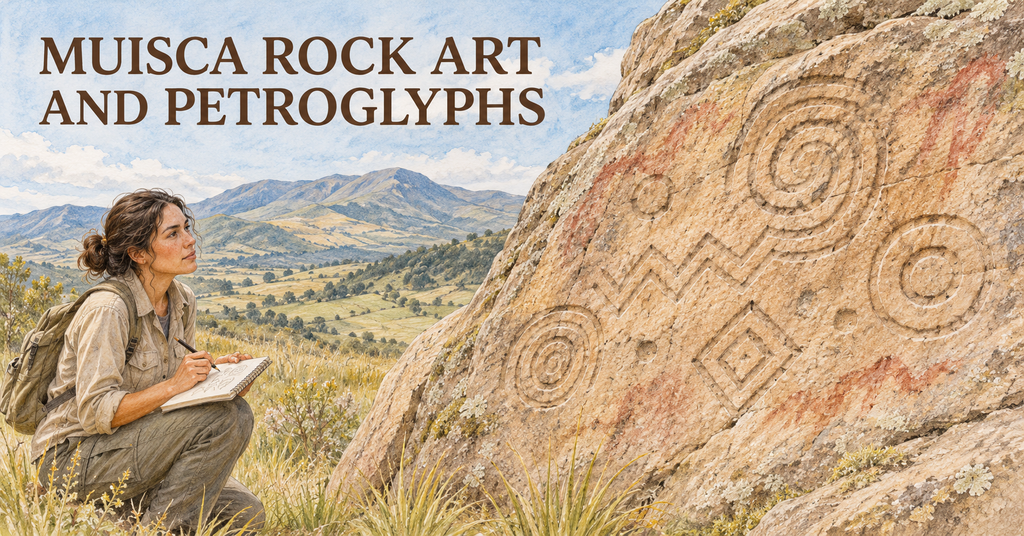
Scattered across the sandstone outcrops of Cundinamarca and Boyacá are thousands of painted and carved rocks. Some show spirals and concentric circles, others human figures with triangular heads, frogs, hands or long zigzag lines, most of them drawn in a rusty red. Many people call all of this “Muisca rock art,” because the Muisca were the dominant people of the region when the Spanish arrived. The reality is more complicated and, for anyone who likes a good puzzle, more interesting.
This guide explains the difference between painted and carved images, where the best-known sites are, what the motifs might mean, why dating them is so hard and how to visit without causing harm. It is written by an independent educational publisher. We do not speak for the Muisca, whose communities today hold their own understandings of these places, and we note where scholars disagree or where an idea rests on legend rather than evidence.
Table of Contents
Painted or Carved: Two Different Crafts
Specialists use two main terms. A pictograph, sometimes called a petrograph in older writing, is an image painted onto rock. A petroglyph is an image cut, pecked or ground into the rock surface. Both occur in the Muisca highlands, but painted images are by far the most visible and the most studied there.
How the Paint Was Made
Most pigments come from iron oxides, the same minerals that make soil reddish. Studies at the Campo de la Batalla de Boyacá, for example, describe red pigment from ochre nodules, ground into powder, moistened and applied with the fingers. Lines are often about the width of a fingertip, which is one way to tell finger painting from brushwork.
A Wider Palette in Some Places
Red dominates, but it is not the only color. At Sáchica, in Boyacá, red, black and white appear together. The rocks of Facatativá show the widest range recorded in the region, including yellow, ochre, blue, black and white alongside red. Black pigment at El Infiernito near Villa de Leyva has even been cited as a hint that some images there are older than the Muisca.
Carvings Are Undercounted
For years, researchers assumed petroglyphs were rare on the plateau. Rock art specialist Guillermo Muñoz has argued that this reflected a lack of fieldwork, not a lack of carvings. In the warmer municipality of El Colegio, southwest of Bogotá, a single survey recorded more than 750 rocks with petroglyphs, plus hundreds of small cup-shaped hollows and grinding stones.
How Many Sites Are There?
The numbers are large. As of 2006, researchers reported 3,487 rock art locations in Cundinamarca alone, with 301 on the Bogotá savanna. Sutatausa, north of Bogotá, has hundreds of painted rocks in a single municipality. Many others sit on private farms, along rural roads or high on cliffs where only climbers reach them. New sites still appear when someone takes the trouble to look.
Much of the early recording, though, was unreliable. Muñoz has pointed out that published copies of famous panels often did not match the originals, and that errors were repeated from book to book. Careful photography and systematic surveys, such as the work of the independent research group GIPRI since the 1970s, have improved the record a great deal.
What the Images Show
Interpretation is guesswork without informed help, but certain motifs recur across the plateau:
- Human figures with triangular heads, painted in red at Soacha and Sibaté and also found at Mongua, Tenjo and Tibacuy.
- “Complex hands” decorated with spirals and concentric circles, recorded at Sibaté, Saboyá and Tibaná.
- Concentric circles and radiating designs, which some researchers link to Sué, the sun, and Chía, the moon.
- Frog-like figures with three-fingered limbs at Gámeza, Pandi and Facatativá. Frogs also appear on Muisca pottery and goldwork.
- Animals such as deer at Mongua and Soacha, birds at Soacha and Sibaté, and a curled-tail quadruped that may represent an opossum.
- Handprints at Soacha and Motavita.
Some writers have suggested that certain images were made in altered states of consciousness during ritual. That idea is a hypothesis, not a finding, and should be presented that way.
The table below compares several well-known locations.
| Site | What it is known for | Condition and access |
|---|---|---|
| Piedras del Tunjo | Large boulders in Facatativá with the region’s widest color range | Public archaeological park; heavily vandalized |
| Sutatausa | Hundreds of painted rocks; excavations found material from many periods | Rural sites; best visited with local guides |
| Soacha and Sibaté | Triangular-headed figures, winged figures, handprints, birds | Threatened by quarrying and urban growth |
| Sáchica | Red, black and white paintings, masked figures, faces without mouths | Near Villa de Leyva; partly on private land |
| Campo de Boyacá | About 22 painted shelters and boulders at the battlefield | Damage from lichen, moss, water and wind |
| El Abra | Rock shelters with some of the oldest human traces on the plateau | Between Zipaquirá and Tocancipá; ICANH protected area, partly private land |
| Suesca | Painted rock faces in a popular climbing area | Graffiti damage; signs ask visitors to help protect it |
Who Made Them, and When?
This is the hardest question, and honest answers start with “we are not sure.” Paint made from mineral pigment rarely contains enough organic material for radiocarbon dating, and carvings contain none. Researchers therefore date rock art indirectly, by excavating the soil at the base of a panel and looking for pigment, tools or charcoal in layers that can be dated.
That approach has produced intriguing results. At the Piedra de Barreiro on the Boyacá battlefield, a hearth with ochre traces nearby gave a radiocarbon date of roughly 210 BCE, and the paintings there have been associated with the Herrera period, which came before the Muisca. Excavations at Sutatausa found objects from several eras, which widens the range of possible authors. Muñoz has gone further, arguing that the label “Muisca” was applied to the region’s rock art largely because colonial records describe the Muisca, not because of firm evidence.
Colonial sources add a telling clue. Sixteenth-century chroniclers reported that the Muisca knew where the paintings were but did not claim to have made them, and considered them very old. A popular legend credits the civilizing hero Bochica with painting the rocks, but specialists treat that link as problematic. The most cautious summary is that the plateau’s rock art was produced over a long period by several peoples, possibly including the Muisca and their predecessors, and that the Muisca gave these places meaning whoever first painted them.
Piedras del Tunjo: A Park With Scars
The best-known site is the Parque Arqueológico de Facatativá, often called Piedras del Tunjo, about an hour west of central Bogotá. Its giant sandstone boulders carry painted images, and the land, once a hacienda, was nationalized in 1946 to create the park. Local history holds that Muisca rulers used the rocks as a refuge during the conquest, and the area is one of several places proposed for the death of the zipa Tisquesusa in 1537, though that remains uncertain.
The park also shows what neglect does. Decades of weak protection allowed graffiti, scratching and other damage that destroyed most of the ancient paintings. Today a metal fence keeps visitors from touching some rock walls, and conservators have run restoration and training projects. Seeing the surviving fragments next to modern scribbles is a sobering lesson in why rules matter.
Threats That Will Not Wait
Colombian heritage specialists agree that people, not weather, now cause most of the damage. The main threats include:
- Graffiti and carving initials, reported at Tunja, Bojacá, Suesca and Facatativá.
- Quarrying and mining, which threaten painted rocks around Soacha.
- Urban expansion and changing land use, as farms around Bogotá turn into housing and industry.
- Burning garbage near rock faces, which leaves soot and heat damage.
- Harmful recording methods, such as chalking lines, making latex casts, rubbing paper over carvings or wetting paintings to make them stand out.
- Natural decay from lichens, moss, fungi, water and wind, which human disturbance often speeds up.
Recording Without Touching
Modern documentation has moved away from chalk and tracing paper. Researchers now rely on high-resolution photography, digital color enhancement that brings out faded pigment on screen, and photogrammetry, which builds 3D models from overlapping images. Terrestrial laser scanning has been used at the Monquirá site near Villa de Leyva, better known as El Infiernito, to map stones and surfaces precisely. These methods let specialists study a panel in detail for years without placing a hand on it.
Good records also serve as insurance. When a boulder is defaced or a quarry advances, careful images may be the only lasting trace of what was there. Volunteers can help by sharing clear, dated photos with researchers or municipal heritage offices, but the same rule applies to everyone: the camera may get close, the fingers may not.
Places That Still Carry Meaning
For some Muisca people today, painted rocks, caves and nearby springs are not relics but living places tied to memory and ceremony. Community views vary, and not every site is considered sacred, but it is wise to assume that a painted rock may matter to someone nearby. Quiet behavior, no offerings left without invitation and no removal of stones or soil are simple ways to respect that possibility.
What Colombian Law Says
Rock art in Colombia is part of the nation’s archaeological heritage. Article 72 of the 1991 Constitution places that heritage under the protection of the state, and rock art sites are treated as cultural property of national interest under the special regime for archaeological heritage. The Colombian Institute of Anthropology and History, ICANH, is the only body legally empowered to apply that regime, which includes authorizing research and interventions.
In practice, that means you cannot legally excavate, remove, repaint or “clean” rock art on your own initiative, even on private land. Damaging it can bring penalties. If you find what looks like an unrecorded site, the right move is to photograph it without touching and report it to ICANH or the municipality.
Visiting Without Leaving a Mark
These habits protect the rocks and make a visit more rewarding:
- Never touch painted surfaces. Skin oils and sweat speed up decay.
- Do not wet, chalk or trace images to photograph them. Use raking light or image enhancement apps instead.
- Stay on marked paths and respect fences, even when no one is watching.
- Hire licensed local guides or join municipal tours, especially at rural sites in Sutatausa, Soacha or Sáchica.
- Ask permission before entering farmland, and respect any Muisca community guidance about sacred places.
- Plan for altitude around 2,600 meters near Bogotá, carry water and layers, and consider travel insurance with medical cover.
If the subject draws you in, university courses in archaeology or Colombian prehistory, or a good Spanish course that lets you read local research, will add more than any number of photos.
Reading Red Lines on Old Stone
The painted and carved rocks of the Colombian highlands are an archive without a catalog. They record centuries of human presence, likely spanning the Herrera and Muisca periods and perhaps earlier, in a visual language we only partly understand. Calling them “Muisca rock art” is convenient but incomplete. What can be said with confidence is that they are fragile, legally protected and threatened mainly by people. Looking carefully, touching nothing and listening to both researchers and Muisca communities is the best way to keep these images readable for those who come next.
Rock Art Questions From First-Time Visitors
Did the Muisca paint all the rock art around Bogotá?
Probably not. Some sites have been linked to the earlier Herrera period, and chroniclers reported that the Muisca regarded many paintings as ancient. The images were likely made over a long span by several groups, with the Muisca among those who used and valued them.
Why is most of the paint red?
The most common pigment was iron oxide from ochre, which is abundant in the region and produces reds and oranges that last a long time on stone. Other colors such as black, white and yellow appear at some sites but are less common.
Can I visit Piedras del Tunjo in a day from Bogotá?
Yes. Facatativá is about an hour west of central Bogotá, depending on traffic, and the archaeological park is open to the public. Check current opening days with the municipality, bring warm layers and keep to the paths and fences.