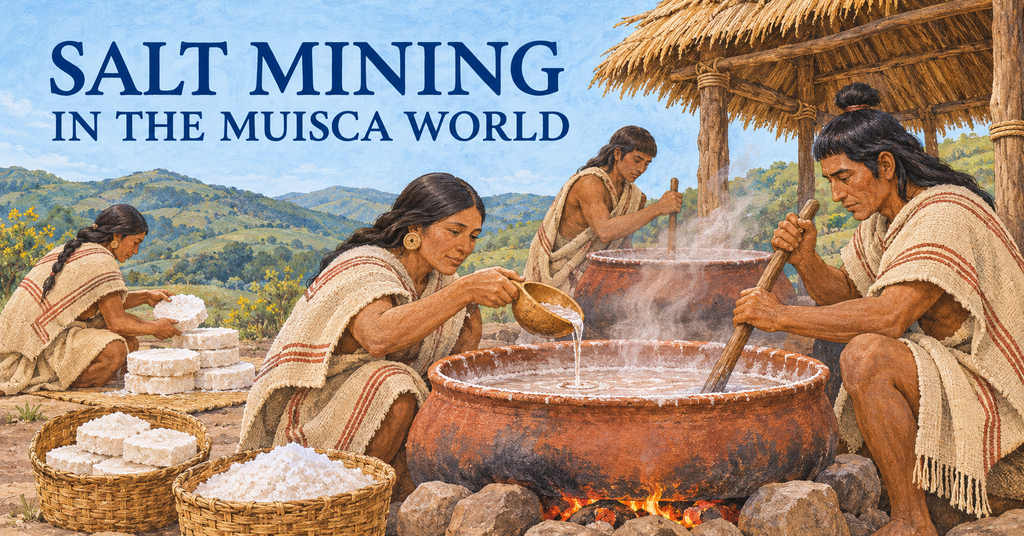
Spanish soldiers who climbed onto the Bogotá savanna in 1537 noticed something odd for a highland people: the Muisca had salt to spare. Not sea salt hauled up from the coast, but bright white cakes made from brine springs a short walk from their villages. Historians sometimes call them the salt people, and the nickname fits because salt sat close to the center of their economy.
This article explains how that salt was made, where, by whom and for how long, and what happened to the industry after the conquest. It separates what archaeologists have measured from what colonial writers reported, and it ends with practical notes for visiting the salt towns north of Bogotá today. We write as an independent educational publisher; we do not speak for present-day Muisca communities, who have their own relationship with these places.
Table of Contents
Why Salt Mattered So Much in the Highlands
Salt is easy to take for granted until it is scarce. People and livestock need it, and before refrigeration it was one of the few reliable ways to keep meat and fish from spoiling. Inland mountain peoples often depended on long trade routes for it. The Muisca were unusual because geology handed them the raw material at home.
The Eastern Cordillera of Colombia holds large deposits of rock salt, formed from ancient evaporated seas and pushed up as the mountains rose. In a few places around Zipaquirá, Nemocón and Tausa, groundwater passing through those deposits emerges as salty springs. For a society that knew how to boil water in pottery, that brine was a gift.
The Main Centers and Their Satellites
Summaries of the Muisca economy identify Zipaquirá, Nemocón and Tausa as the principal salt sources, with smaller production at Sesquilé, Gámeza and Guachetá. Zipaquirá and Nemocón lie within a short distance of each other north of Bogotá, and Tausa sits a little farther on. All three were tied to the political sphere of the zipa, the ruler based at Bacatá on the savanna.
From Brine to White Cakes: The Process
Archaeologist Marianne Cardale de Schrimpff, whose work at Zipaquirá and Nemocón laid the foundation for later research, described the basic technique in a publication of the Museo del Oro. Brine collected at the springs was boiled in clay vessels until the water was gone, leaving a fine white block of salt shaped by the pot. Those cakes were the trade product.
- Collecting brine. Salty water was drawn from springs that rose through the salt-bearing rock.
- Filling the pots. Workers poured brine into large ceramic vessels, known in Spanish sources as gachas.
- Heating. The vessels sat over fires for long periods. Summaries note that coal from local sediments was available for fuel, alongside wood.
- Breaking the pot. Once the water had evaporated, the vessel was often broken to free the salt, which is why production sites are buried in pottery fragments.
- Trading the cakes. The finished salt traveled to markets and on to other regions.
Who Did the Work
Accounts of Nemocón’s history describe Muisca women boiling brine in large pots, and summaries of Muisca crafts credit women with making the gacha vessels. That suggests salt production was closely tied to women’s labor and skills in pottery. How work was split between households, specialists and local leaders is less clear, and researchers continue to debate it.
Mountains of Broken Pottery
The strongest physical evidence for Muisca salt making is not salt at all. It is the debris. Because pots were so often broken after use, the hills around the springs filled up with sherds, layer upon layer, for centuries.
At Nemocón, anthropologist Ana María Groot of the Universidad Nacional de Colombia described a midden on the salt hill covering about 100 by 40 meters, with deposits 2 to 8 meters deep. Thick bands of sherds from salt-boiling vessels alternate with house floors, showing people lived right on top of their workplace. She also noted that later salt workers moved piles of sherds around, which complicates the stratigraphy.
How Old Is It?
Radiocarbon dates place the start of salt production well before the Muisca period as archaeologists define it. Cardale dated the beginning of the Nemocón midden to about 2,210 years before present, during the Herrera period. A 2024 doctoral thesis at the Universidad de los Andes by Saúl Alberto Torres Orjuela pushed the chronology to at least 2,300 years ago, using geophysical survey, sediment chemistry and analysis of charred wood from the Checua River valley.
In other words, salt making at Nemocón predates the Muisca polities that met the Spanish by more than a thousand years. The industry grew across many generations, and the people who ran it in 1537 inherited both the springs and a very old body of practical knowledge.
Scale and Fuel
How big was the industry? Cardale offered an estimate that salt production at Zipaquirá, Nemocón and Tausa supported a population of around 30,000 people by the first century AD. Numbers like that rest on assumptions about output and consumption, so they are best read as an order of magnitude rather than a census. Even so, they show salt was a serious regional enterprise, not a cottage sideline.
Boiling brine for hours on end demands a great deal of fuel. That is why Torres Orjuela’s study examined charred wood from the excavations: identifying which trees were burned helps show how salt makers used the surrounding vegetation and whether they changed it over time. Local coal seams also offered an alternative fuel. Questions about fuel supply link Muisca salt to broader debates on how pre-Hispanic societies shaped the Andean landscape, a topic that interests ecologists as much as archaeologists.
Before Pots Were Used
Cardale also suggested that, before evaporation in pottery became common, people may simply have carried brine away from the springs in containers or bags. That kind of practice leaves almost no trace, so it can be inferred but not easily proven.
An Even Older Story Nearby
About seven kilometers north of Nemocón’s town center lies Checua, a site Groot first investigated, with radiocarbon dates around 6500 BCE. Checua belongs to early hunter-gatherer and pre-ceramic times rather than salt boiling, but it shows how long people have lived in this valley. For visitors, it is a reminder that the salt story sits inside a far longer human history.
| Place | Main evidence | Key points |
|---|---|---|
| Nemocón | Deep sherd midden on the salt hill | Production from at least about 2,300 years ago; market town |
| Zipaquirá | Settlement remains and colonial records | Earliest settlement in the Herrera period; Muisca markets held every four days |
| Tausa | Named as a principal source | Less studied than its neighbors |
| Minor sites | Sesquilé, Gámeza, Guachetá | Smaller production, mostly known from summaries |
| Checua | Pre-ceramic camp near Nemocón | Dated around 6500 BCE; not a salt site, but shows deep occupation |
| Salt Cathedral | Modern Catholic sanctuary in the Zipaquirá mine | Current church opened in 1995; landmark, not an archaeological site |
Salt on the Move: Markets and Exchange
Muisca salt was not only for home use. It was a major exchange good, traded for things the cold highlands could not easily produce. Summaries of the Muisca economy list cotton, mantles and emeralds among the goods swapped for salt, and note that gold was sometimes exchanged for it too. Some sources describe salt reaching peoples to the west and south of the highlands.
Market Towns
Zipaquirá held a market every four days, according to colonial-era descriptions, and Nemocón also functioned as a market town where salt was sold. Regular markets let producers, weavers, farmers and traders meet without depending entirely on chiefs. In a 1558 letter cited by historians, Spanish officials complained that barter, including in salt, let people evade taxes, which shows the system outlived the conquest for a time.
What Salt Bought
- Cotton from warmer valleys, essential for mantles since highland cotton grew poorly.
- Finished mantles, which also served as tribute and stores of value.
- Emeralds, which also moved through highland exchange networks.
- Tropical produce such as fruits and coca from lower elevations.
- Gold, which reached the highlands largely through exchange rather than local mining.
Salt in the Kitchen
At home, salt preserved fish and meat and flavored daily food. Accounts of Nemocón note its use for drying fish and meat, which mattered for a diet that included lake fish, guinea pig and, for those permitted, deer. Its role in cooking is one reason salt was valued everywhere it traveled.
What the Conquest Did to Muisca Salt
The salt springs drew Spanish attention almost immediately. Nemocón, a salt-producing settlement, was where Gonzalo Jiménez de Quesada’s expedition met its first armed resistance on the Bogotá savanna. Control over the brine became a source of colonial revenue in the decades that followed.
Colonial authorities also reorganized the towns. Records show that a royal inspector, Luis Henríquez, ordered Zipaquirá’s settlement moved in 1600, and modern Nemocón dates its foundation to 26 July 1600 under the same official. Over the following centuries, production shifted from Indigenous brine boiling toward mining rock salt directly, and eventually to state-controlled industrial operations.
Two Underground Churches: The Salt Cathedral
Many visitors first meet this history at the Salt Cathedral of Zipaquirá. It is important to be clear about what it is. The cathedral is a modern Catholic sanctuary carved inside a working salt mine, not a Muisca site, and it does not represent Muisca religion.
Miners carved a small prayer space underground around 1932. A larger cathedral, dedicated to Our Lady of the Rosary, was inaugurated on 15 August 1954. Structural and safety problems led authorities to close it in 1992. A new cathedral, designed by architect Roswell Garavito Pearl after a design competition, opened on 16 December 1995 about 200 meters underground. Nemocón also has a salt mine and museum open to the public.
How to Visit With Context
- Pair the mine with a museum. The Museo del Oro of the Banco de la República and the Museo Nacional in Bogotá help explain the pre-Hispanic economy before you go underground.
- Mind the altitude. Bogotá sits around 2,600 meters, and Zipaquirá and Nemocón are similar. Walk slowly, drink water and carry travel insurance that covers medical care.
- Hire licensed guides. In smaller towns and rural sites, a guide registered with Colombia’s national tourism registry can add history and keep you off private or protected land.
- Respect sacred places. Some springs, hills and lagoons in the region remain meaningful to Muisca communities, whose cabildos operate in Suba, Bosa, Cota, Chía and Sesquilé. Follow local guidance and do not collect sherds or stones.
For Students
The salt towns make a strong case study for courses in archaeology, economic anthropology or environmental history. Spanish reading skills open up most of the research, much of it published by Colombian universities and the Instituto Colombiano de Antropología e Historia. Field schools and museum programs occasionally welcome international learners.
The White Thread Through Muisca History
Salt connects nearly every part of the Muisca story. It explains why dense settlement grew around a few springs north of Bogotá, why women’s pottery skills mattered so much, how highland communities obtained cotton, emeralds and gold, and why Spanish officials moved quickly to control the brine. The broken pots piled meters deep at Nemocón are an archive of more than two thousand years of patient work.
Seen that way, a visit to Zipaquirá or Nemocón is more than a trip to a striking underground church. It is a chance to stand where generations of Muisca families turned salty water into one of the most valuable goods in the northern Andes.
Salt Questions, Plainly Answered
Did the Muisca mine rock salt or boil brine?
The best-documented pre-Hispanic method was boiling brine from springs in clay pots until only salt remained. Some summaries say parts of the old galleries at Zipaquirá began with Indigenous work, but large-scale tunnel mining of rock salt is mainly a colonial and later development.
Is the Salt Cathedral a Muisca temple?
No. It is a Catholic sanctuary built inside a modern mine. The first cathedral opened in 1954, and the current one in 1995. It stands on ground with a long salt history, but it is not an Indigenous religious site.
How far did Muisca salt travel?
Far enough to be a regional trade good. It was exchanged for cotton, mantles, emeralds and gold, and sources describe it reaching neighboring peoples outside the highlands. Exact routes and volumes are still being worked out by archaeologists.